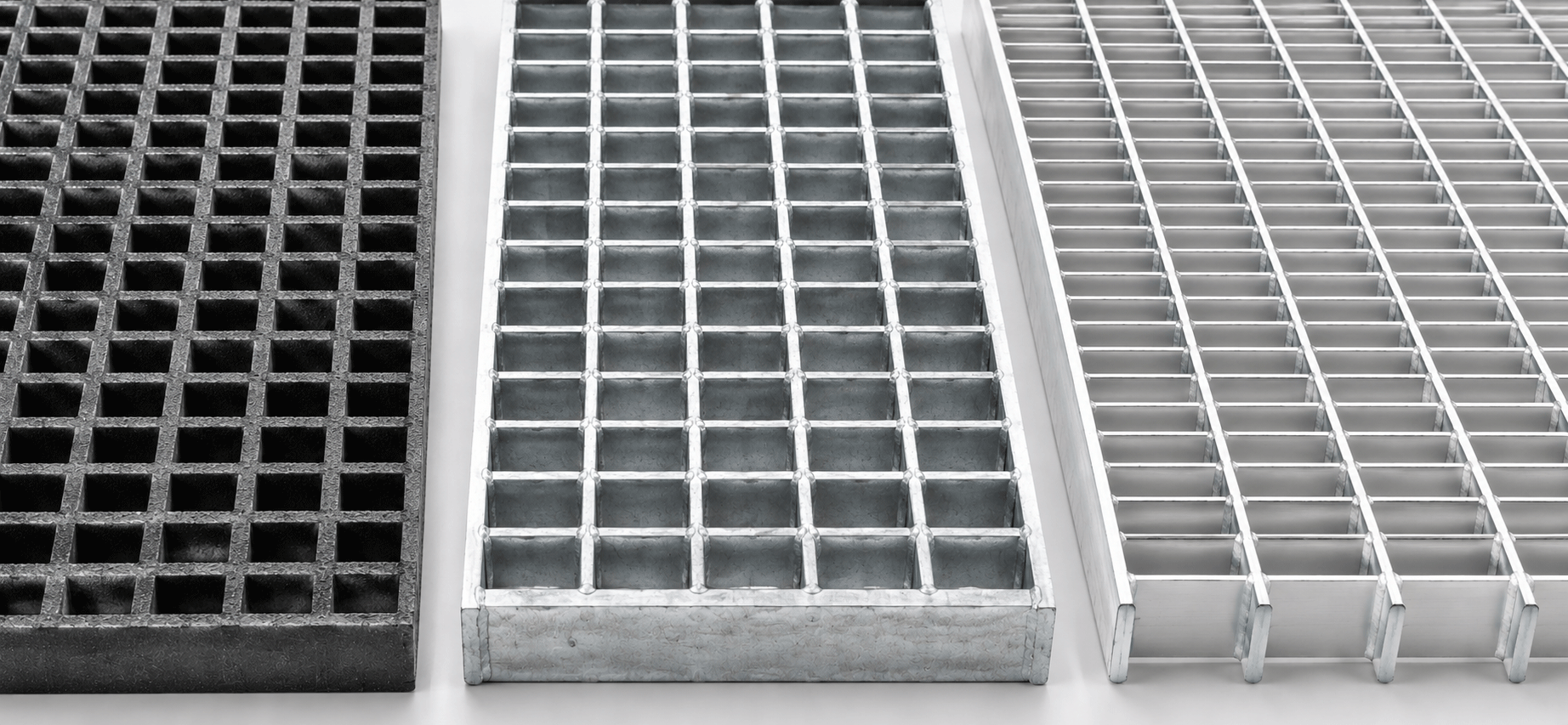
When specifying grating for industrial walkways, maintenance platforms, rooftop mechanical access, or utility infrastructure, engineers and designers typically evaluate three primary materials: fiberglass reinforced plastic (FRP), steel, and aluminum.
Each material has distinct advantages depending on the environment, structural requirements, maintenance expectations, and budget. While steel has long been the standard for heavy-duty industrial applications, FRP grating has become an increasingly popular alternative for facilities where corrosion resistance, lightweight construction, and long-term durability are priorities. Aluminum also fills an important niche where reduced weight and moderate corrosion resistance are desirable.
This guide compares the three materials across the performance characteristics that matter most, helping you determine which grating material is best suited for your application.
| Feature | FRP Grating | Steel Grating | Aluminum Grating |
|---|---|---|---|
| Corrosion Resistance | Excellent | Fair | Good |
| Weight | Excellent/Lightest | Poor/Heavy | Good |
| Slip Resistance |
Excellent (w/ bonded grit) ASTM E303-22 | Good | Good |
| Electrical Conductivity | Non-Conductive | Conductive | Conductive |
| Maintenance | Excellent/Minimal | Good | Good |
| Load Capacity | Good | Excellent | Good |
| Installation | Excellent/Easy | Fair | Good |
| View Product |
FRP vs. Steel vs. Aluminum Grating Comparison
FRP Grating
Steel Grating
Aluminum Grating
Corrosion Resistance
Excellent
Fair
Good
Weight
Excellent/Lightest
Poor/Heavy
Good
Slip Resistance
Excellent (w/ bonded grit)
ASTM E303-22
Good
Good
Electrical Conductivity
Non-Conductive
Conductive
Conductive
Maintenance
Excellent/Minimal
Good
Good
Load Capacity
Good
Excellent
Good
Installation
Excellent/Easy
Fair
Good
Which Grating Material Performs Best in Corrosive Environments?
Corrosion is one of the most important considerations when selecting grating for industrial facilities. Rooftop mechanical systems, cooling towers, wastewater plants, chemical processing facilities, and coastal environments continually expose materials to moisture, salts, and corrosive chemicals that can shorten service life.
FRP Grating
Fiberglass reinforced plastic is inherently corrosion resistant and will not rust. Molded FRP grating performs exceptionally well in wet, chemical, or coastal environments without requiring protective coatings or periodic repainting.
Steel Grating
Carbon steel provides excellent structural performance but is susceptible to corrosion if protective coatings become damaged. Galvanized steel significantly improves corrosion resistance, while stainless steel offers the highest durability but at a considerably higher cost.
Aluminum Grating
Anodized Aluminum has a protective oxide layer that provides good corrosion resistance in many outdoor applications. However, certain chemical environments may still affect long-term performance. Anodized layers are also vulnerable to scratches which exposes the un-anodized aluminum.
Bottom Line: FRP is often the easiest material to transport, fabricate, and install, particularly on rooftops or other difficult-to-access locations.
Which Material Provides the Best Slip Resistance?
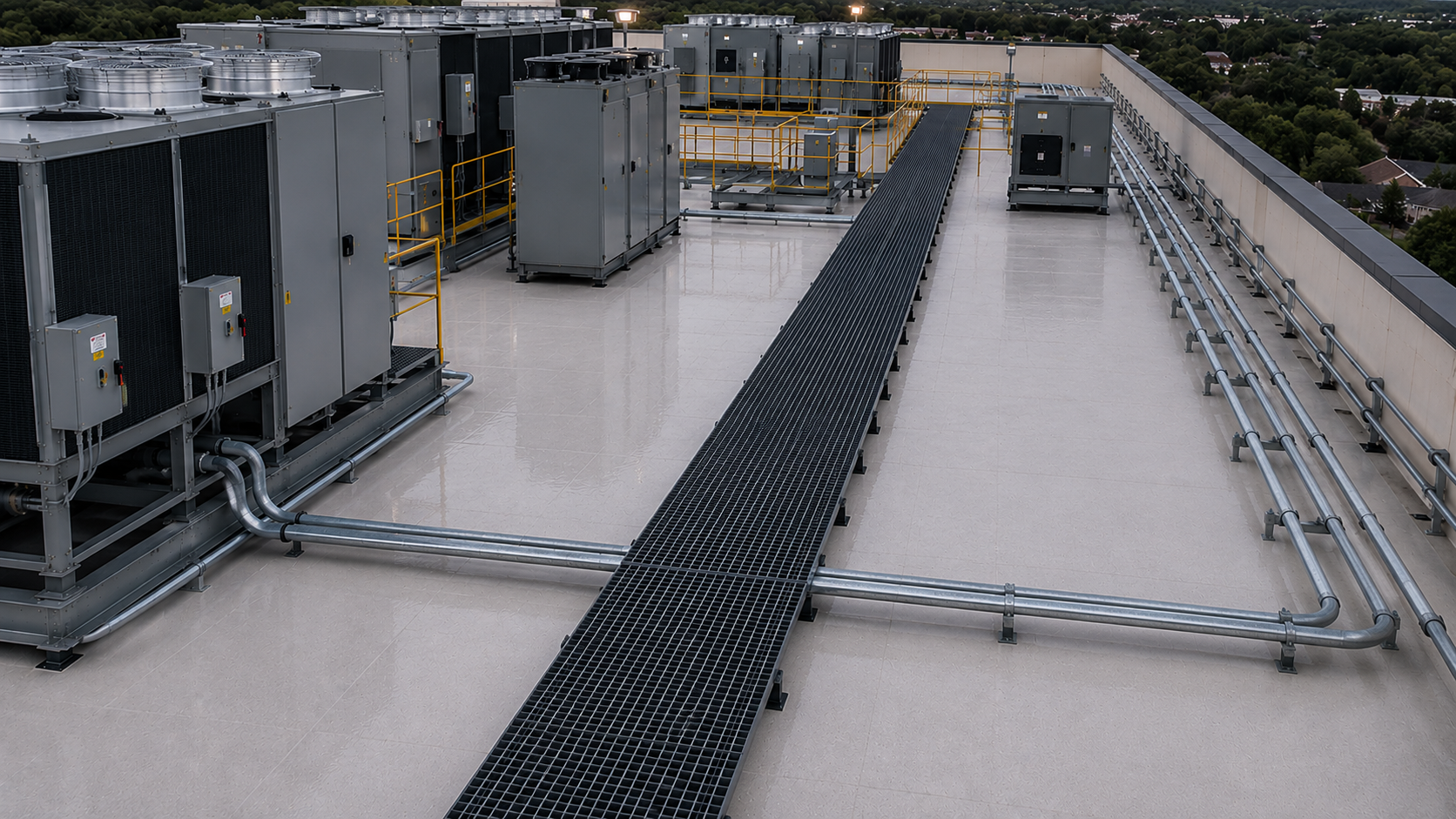
Safe footing is essential for industrial walkways, maintenance platforms, and equipment access areas where water, dust, or debris may be present.
FRP Grating
Many molded FRP gratings incorporate an integral bonded or molded grit surface designed to provide long-lasting slip resistance in wet industrial environments. Unlike applied coatings that can wear over time, the slip-resistant surface becomes an integral part of the panel. For example, Archatrak SpanTrak FRP grating achieves a wet Pendulum Test Value (PTV) of 72 when tested to ASTM E303-22, nearly twice the commonly recommended minimum value for exterior walking surfaces.
FRP Slip Testing DataSteel Grating
Steel grating commonly uses serrated bearing bars to improve traction. While effective, slip performance can vary depending on wear, coatings, and environmental conditions.
Aluminum Grating
Textured aluminum surfaces improve traction but generally provide less aggressive slip resistance than molded gritted FRP products.
Bottom Line: For demanding industrial environments where slip resistance is a priority, molded FRP grating offers excellent long-term performance.
Which Material Is Easier to Transport and Install?
Installation costs are influenced not only by material price but also by handling, transportation, and onsite fabrication.
FRP Grating
FRP panels are significantly lighter than comparable steel panels and can typically be carried and installed with fewer workers. Panels can also be cut and fabricated onsite using standard power tools, simplifying installation around existing equipment. * Note, that appropriate safety precautions should be taken when cutting fiberglass.
Steel Grating
Steel provides exceptional strength but is also the heaviest option. Larger panels often require lifting equipment, and field modifications may involve specialized cutting or welding.
Aluminum Grating
Aluminum offers many of the weight advantages of FRP while remaining a metal product. It is easier to handle than steel but still requires conventional metal fabrication techniques.
Bottom Line: For highly corrosive environments, FRP generally provides the longest service life with the least maintenance.
Which Material Is Safest Around Electrical Equipment?
Facilities containing electrical infrastructure require careful consideration of worker safety.
FRP Grating
FRP is electrically non-conductive, making it well suited for applications around switchgear, substations, electrical equipment, and data center infrastructure.
Steel Grating
Steel is electrically conductive and must be properly grounded where required.
Aluminum Grating
Like steel, aluminum is also electrically conductive.
Bottom Line: FRP offers a significant safety advantage wherever electrical isolation is important.
Which Material Supports the Heaviest Loads?
Structural loading is often the primary factor when selecting industrial grating. Engineers evaluate the anticipated live loads, concentrated loads, allowable deflection, support spacing, and span length before selecting a grating material. While all three materials can be engineered for industrial applications, their structural characteristics differ significantly.
FRP Grating
Modern molded FRP grating is engineered to support pedestrian traffic, maintenance equipment, carts, and service loads when properly specified. Panel thickness, mesh configuration, and support spacing all influence load capacity, making FRP an excellent choice for most industrial walkways, service platforms, rooftop access systems, and trench covers.
Load Deflection DataSteel Grating
Steel provides the highest load capacity and stiffness of the three materials, allowing longer unsupported spans and heavier concentrated loads. For applications involving forklifts, heavy equipment, or exceptionally high design loads, steel often remains the preferred structural solution.
Aluminum Grating
Aluminum offers a balance between weight and strength. While generally stronger than FRP on a pound-for-pound basis, aluminum does not typically match the span capabilities of steel and is more commonly specified where weight reduction is important.
Bottom Line: When maximum structural capacity or long unsupported spans are required, steel remains the benchmark. For most pedestrian and maintenance access applications, however, properly engineered FRP grating provides more than adequate strength while offering significant advantages in corrosion resistance, weight, and maintenance.
Which Material Has the Lowest Long-Term Maintenance Costs?
While initial material cost is often the first consideration, it rarely tells the full story. Installation labor, maintenance requirements, service life, and replacement costs all contribute to the total cost of ownership over the life of a facility.
FRP Grating
The initial purchase price of molded FRP grating is often comparable to, or slightly higher than, galvanized steel depending on panel size and specifications. However, its corrosion resistance, low maintenance requirements, and long service life frequently result in the lowest life-cycle cost, particularly in corrosive or outdoor environments.
All FRP Downloadable ResourcesSteel Grating
Carbon steel typically has the lowest upfront material cost, making it an economical choice for many industrial applications. However, installations costs, ongoing maintenance, protective coatings, and potential replacement due to corrosion can significantly increase ownership costs over time.
Aluminum Grating
Aluminum generally commands a higher initial price than carbon steel while offering improved corrosion resistance and reduced maintenance. It provides a balance between durability and weight but is often selected for specific applications rather than lowest overall cost.
Bottom Line: If minimizing upfront cost is the priority, carbon steel is often the most economical choice. When evaluated over decades of service, FRP frequently provides the best long-term value by reducing maintenance, extending service life, and lowering replacement costs.
Choosing the Right Grating Material
Every project has different priorities. Selecting the right material depends on balancing structural requirements, environmental exposure, installation constraints, and long-term maintenance expectations.
Steel, aluminum, and FRP grating each have an important place in industrial construction. Steel remains the preferred solution for applications requiring maximum structural capacity, while aluminum offers a lightweight metallic alternative for many outdoor installations.
For maintenance walkways, service platforms, rooftop mechanical systems, utility trench covers, cooling towers, wastewater facilities, and other corrosive environments, molded FRP grating continues to gain popularity because it combines corrosion resistance, low maintenance, lightweight installation, and long-term durability in a single solution.
Learn More about SpanTrak FRP Talk to an FRP Expert