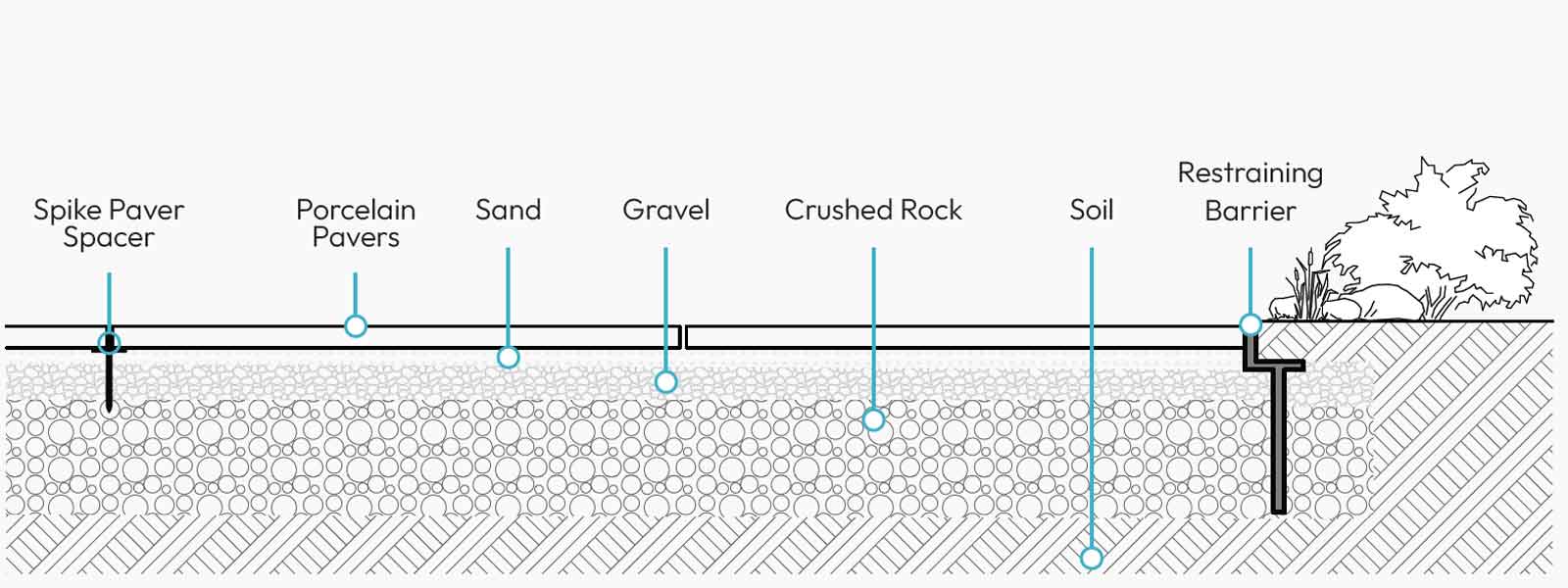
Dry laying on sand is recommended for non-vehicular applications such as garden landscaping, patios, courtyards, walkways and terraces.
1
Step One
After defining the area to be excavated, mark the perimeter using wooden or steel marker posts connected by a string. Note that the excavated area should be extended on all sides by approx. 6”-8” to ensure stability at the outer edges of the paved area.
2
Step Two
Remove the soil inside the marked area using a shovel or excavator. The depth of excavation will depend on several factors including the anticipated loading, the drainage capacity of the soil and the soil conditions in general.
3
Step Three
Using a rake or shovel, level the excavated area and ensure there is at least 2% slope for good drainage. Compact the soil with a vibro compactor.
4
Step Four
A restraining perimeter wall should be installed prior to laying the gravel/sand bed unless it is in direct contact with a footpath, wall or an existing edge that is sufficiently rigid. The perimeter wall should be fixed to the ground with mechanical fixing devices or constructed as a solid barrier using poured concrete.
5
Step Five
Place a sheet of geotextile fabric on top of the compacted soil to prevent the soil from mixing with the gravel.
6
Step Six
Fill the excavated area with ¾” stone screenings to a thickness of 8” – 12”, depending on the planned loading.
7
Step Seven
Add a further layer of 3/8” gravel to a thickness between 4”- 8”. Compact the two layers and then level, ensuring there is a slope of approx. 2%.
8
Step Eight
Place a sheet of geotextile fabric on top of the compacted gravel to prevent the gravel from mixing with the sand.
9
Step Nine
Fill the area with sand to a thickness of between ¾” and 2” and compact with a vibro compactor.
10
Step Ten
Level the surface by sliding a wood or steel board placed on two parallel runners across the entire area, again ensuring there is a slope of approx. 2%.
11
Step Eleven
Taking care not to disturb the sand bed, lay the pavers using 3/16” min. spacers. Carefully tap the pavers with a rubber mallet to ensure they are not rocking on the sand bed and that they are level with each other.
Last Update