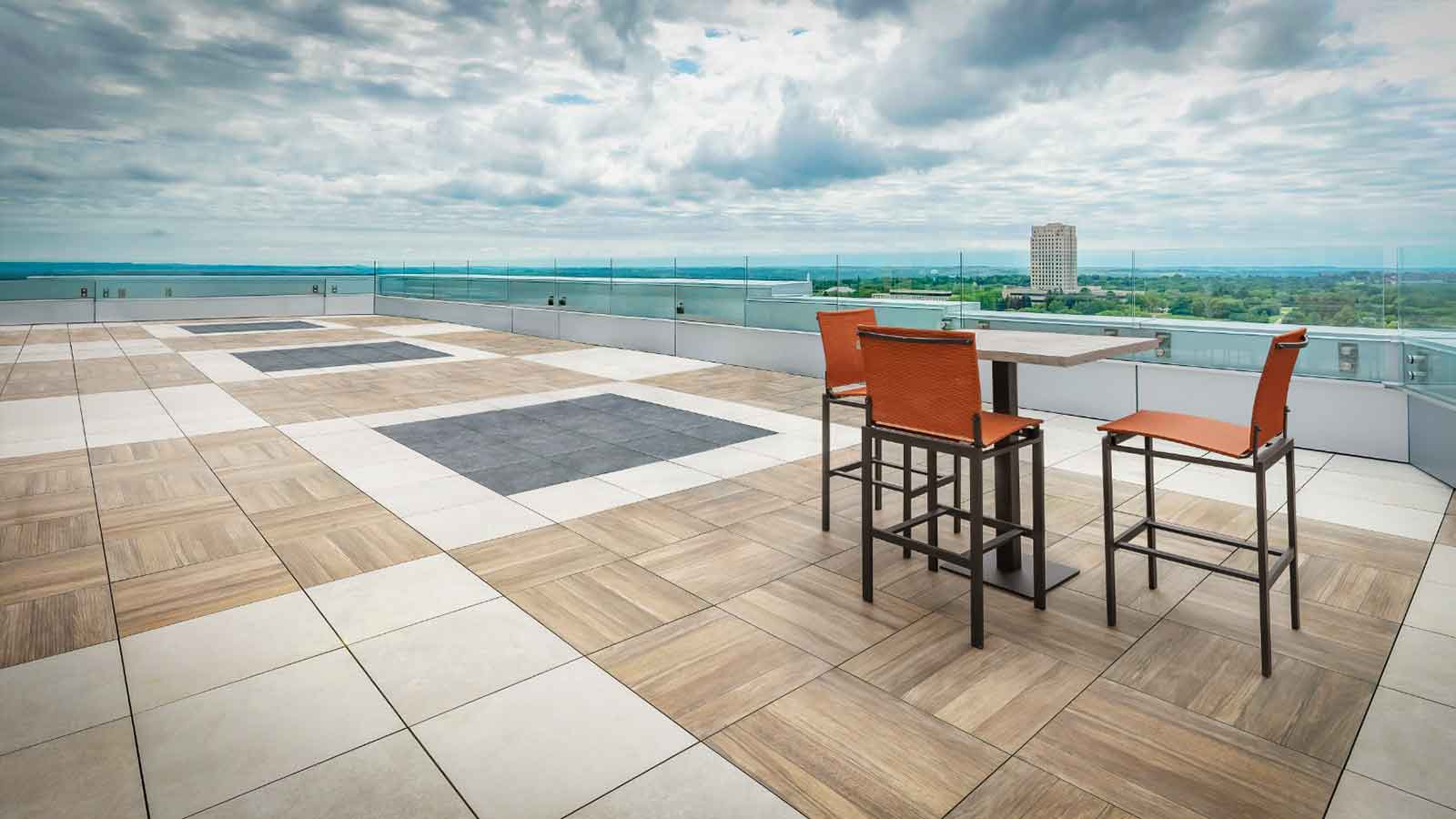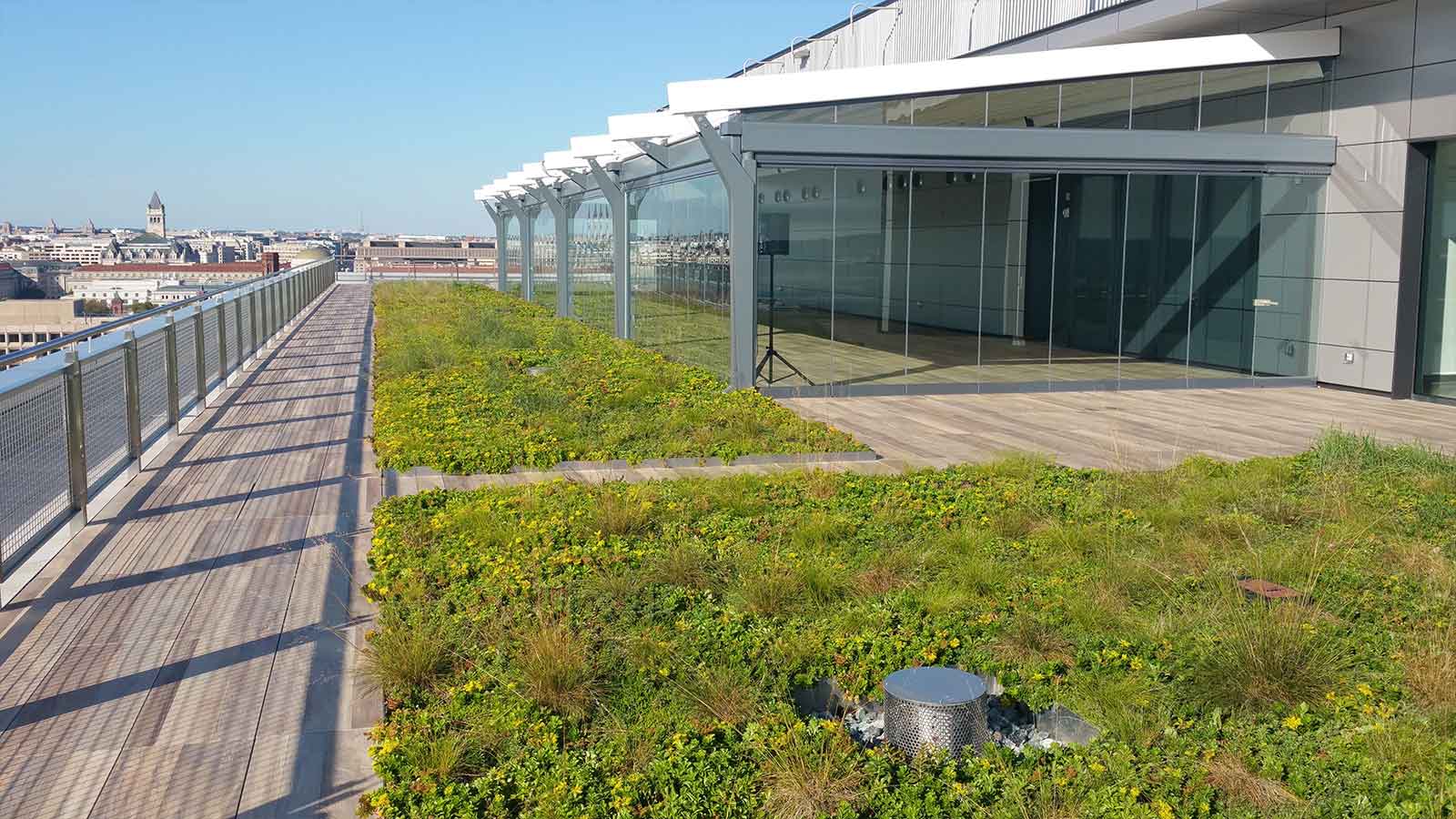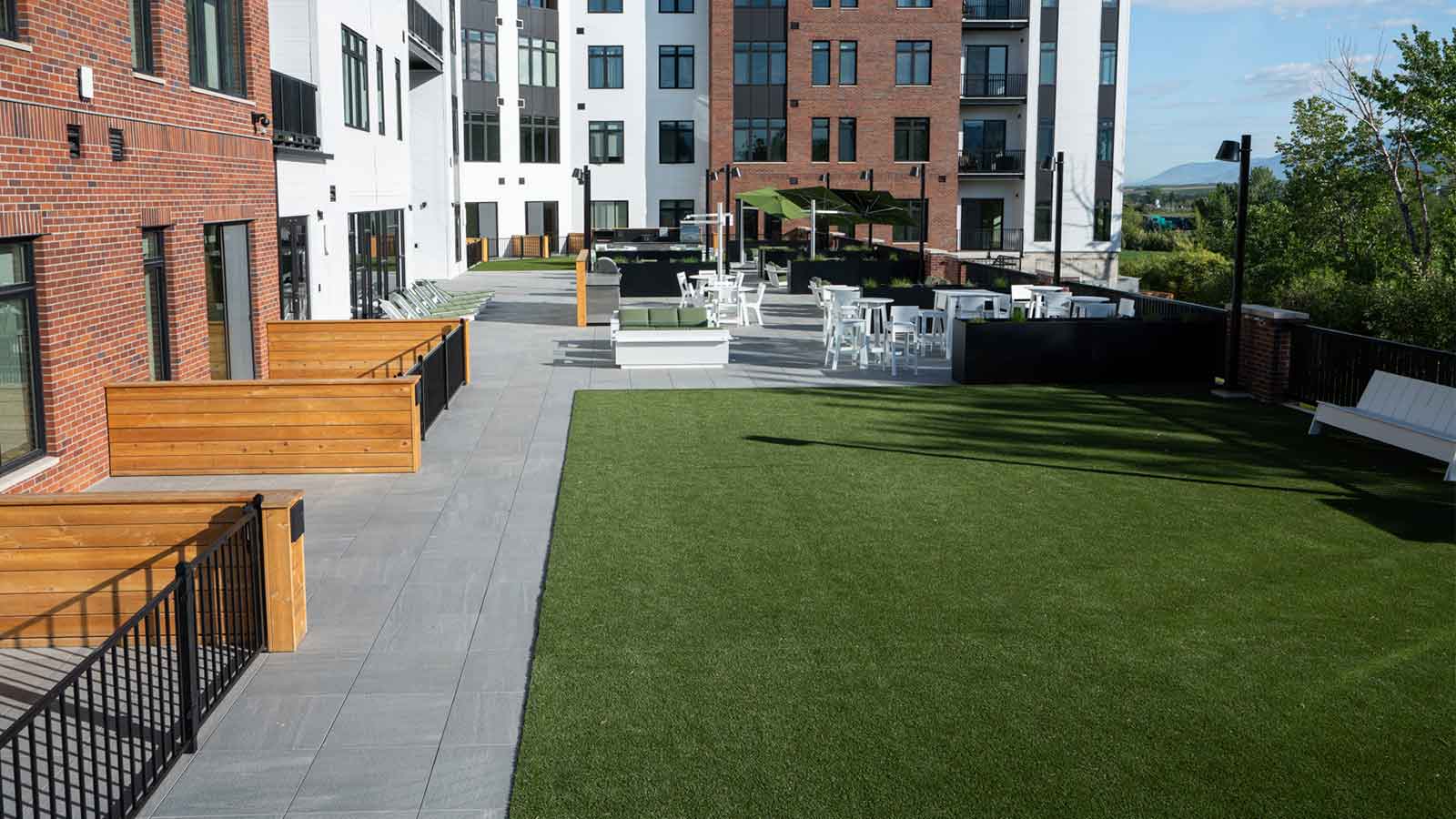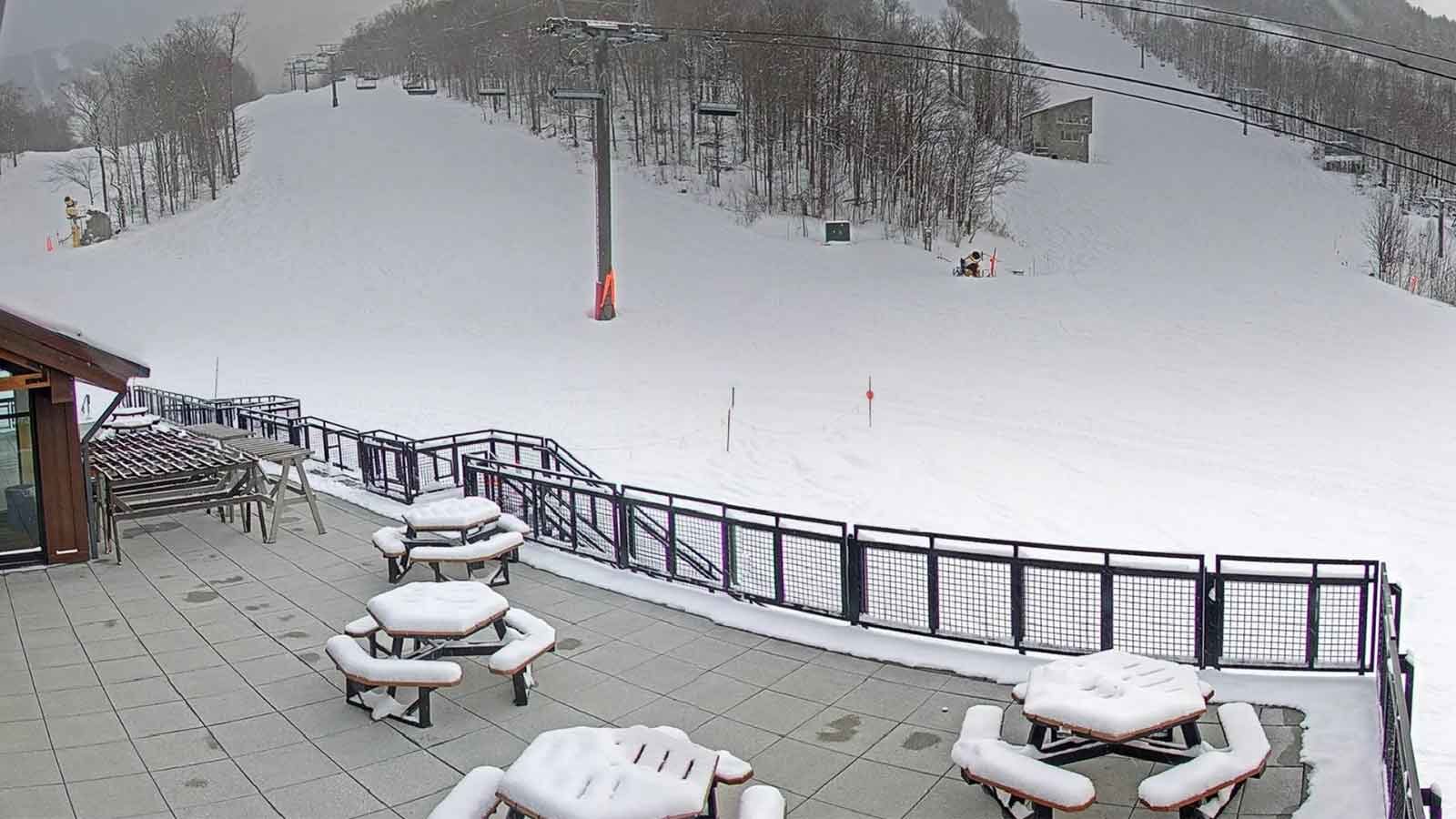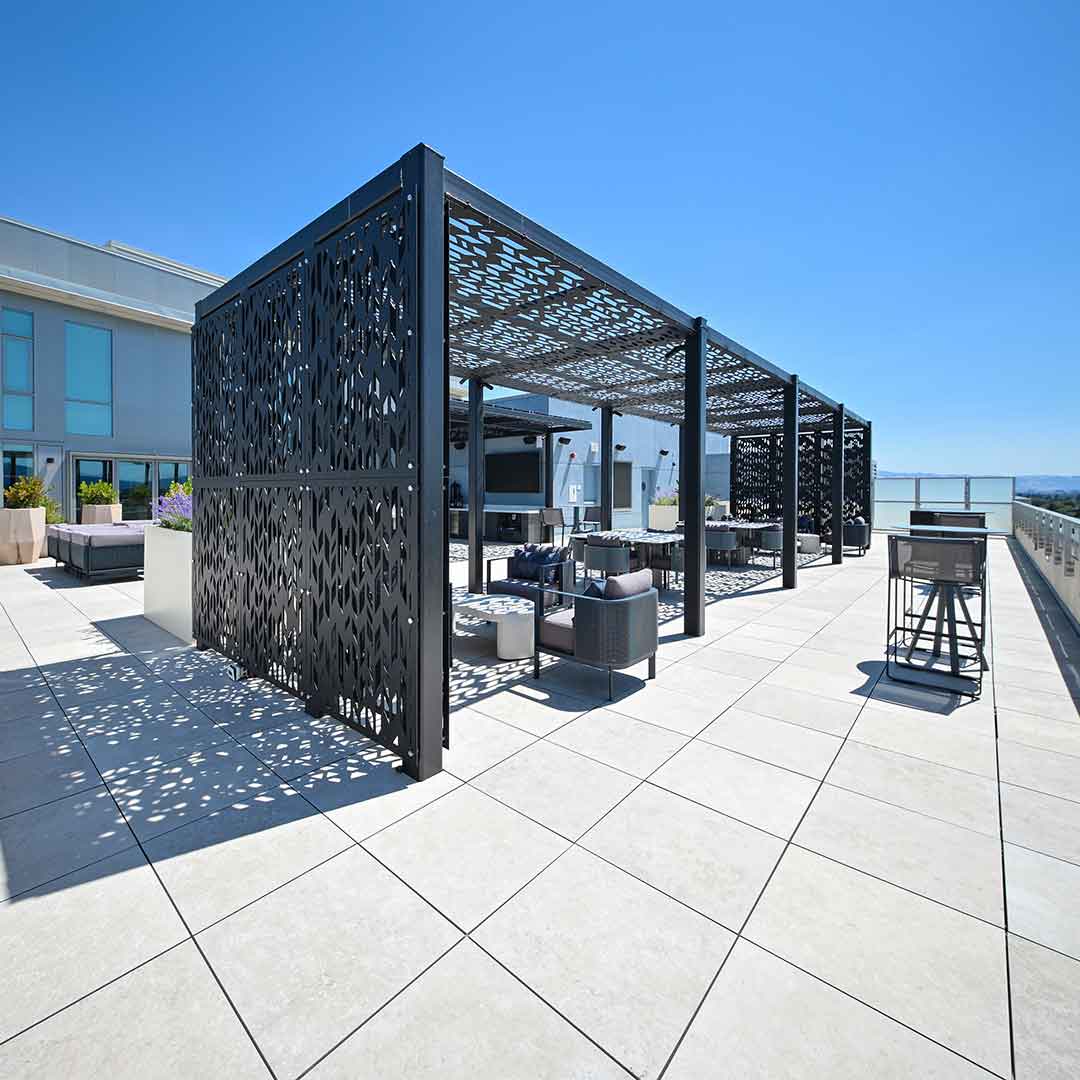
Rooftops are subject to wind conditions and forces, particularly on taller buildings and in exposed locations. In paver and pedestal systems, these forces may cause individual pavers to become displaced or airborne, especially at roof edges and corners.
Archatrak has developed two concealed paver locking systems to interconnect pedestal-supported porcelain pavers and reduce the risk of wind uplift, with dedicated systems for 2 cm and 3 cm pavers. Both systems utilize adjustable-height steel pedestals to provide enhanced hold-down capability while supporting fully non-combustible rooftop deck assemblies.
Independent wind tunnel research has demonstrated that:
- The most effective method for mitigating wind uplift is to mechanically lock pedestal-supported pavers together so they act as a single rigid assembly
- Pavers located at exposed corners and extending along the perimeter are the highest priority and most vulnerable to uplift forces
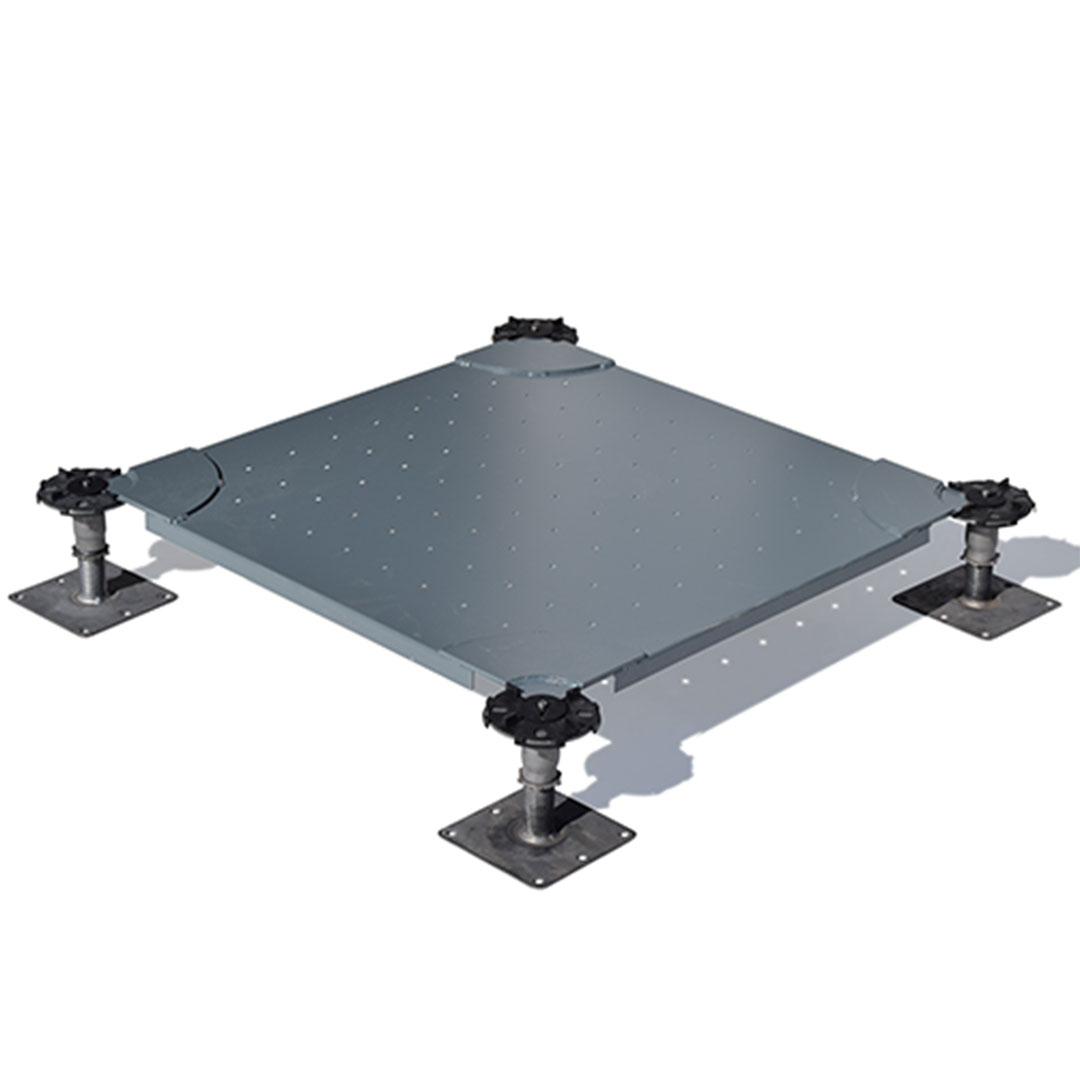
2cm Paver Hold Down – Bonded to ‘SpanSafe’ Steel Trays
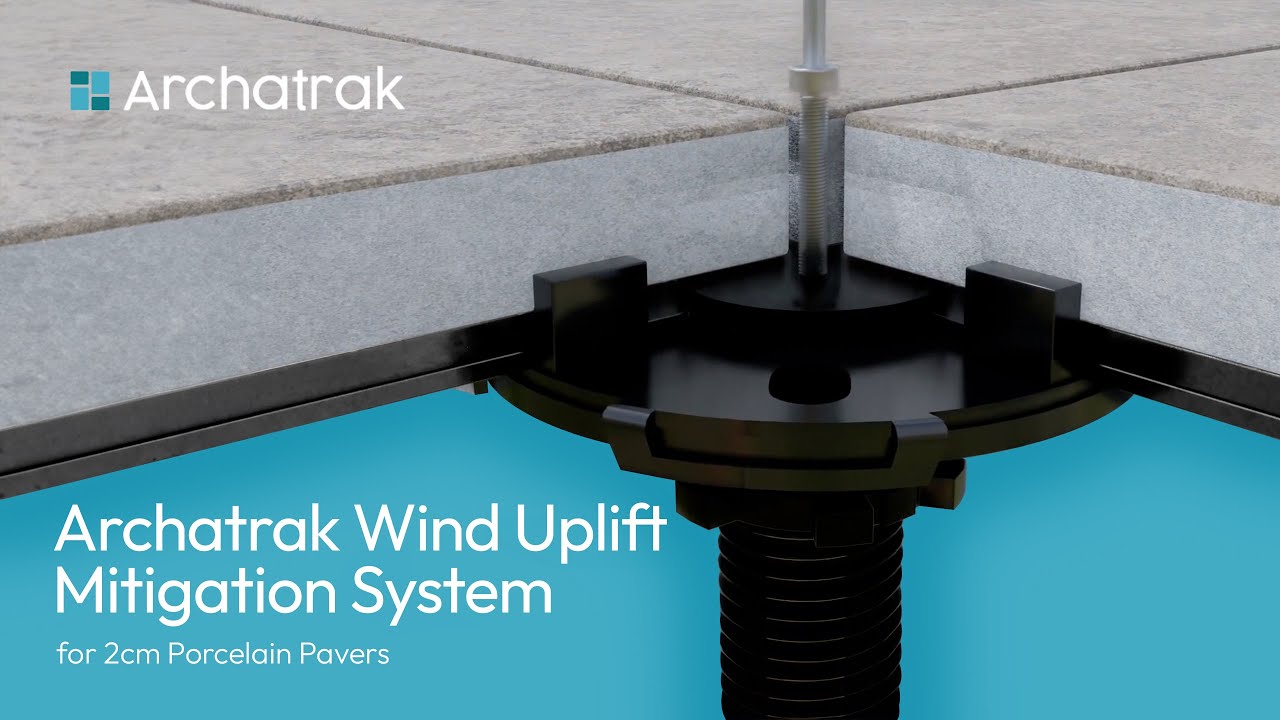
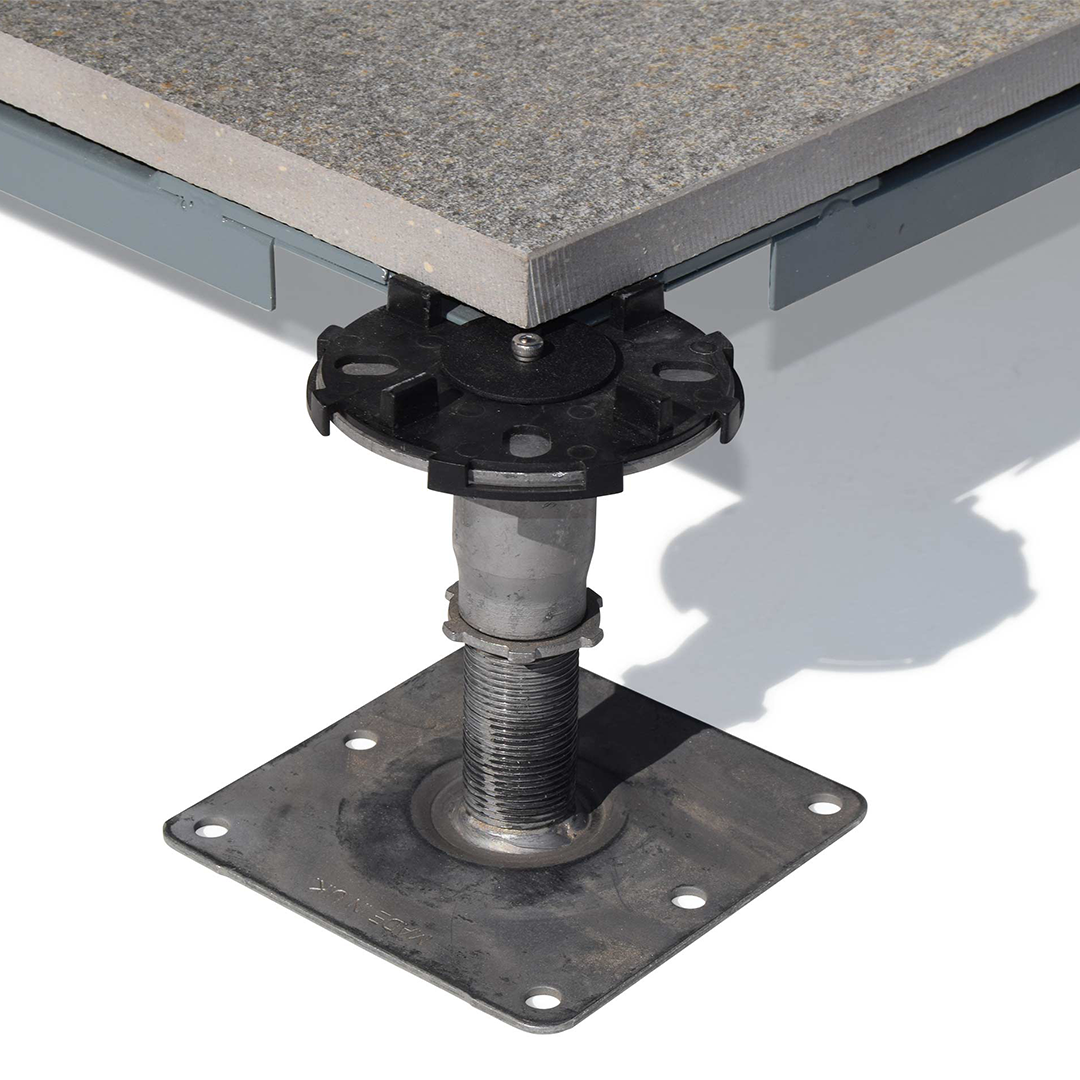
Because 2 cm porcelain pavers are not thick enough to safely accept kerf cuts at each corner without compromising structural integrity, Archatrak uses a mechanically restrained, tray-based system to mitigate wind uplift. In this configuration, 2 cm pavers are bonded to Archatrak SpanSafe steel protection trays with raised corner supports using industrial adhesive, and the trays are secured to steel pedestals, forming a restrained array designed to resist uplift forces.
The system relies on the combined performance of structural adhesive bonding, mechanical fastening, and steel support components to maintain paver position under wind loading conditions.
System components and tested performance:
- 2 cm porcelain pavers: Bonded to raised corner supports on Archatrak SpanSafe steel protection trays
- Tray fastening: Trays are mechanically secured to Incendio adjustable-height steel pedestals using bolt-and-washer assemblies
- Surface appearance: No visible fixing devices on the deck surface
- Steel pedestal resistance: Steel pedestals provide resistance to fastener pull-out under wind uplift loading
- Testing standard: Tested in accordance with ASTM E330 for structural performance under uniform static air pressure difference
- Performance data: Wind uplift testing demonstrated an average failure pressure of 183 psf*
3cm Paver Hold Down – Kerf Cut Corners with Hold Down Washer
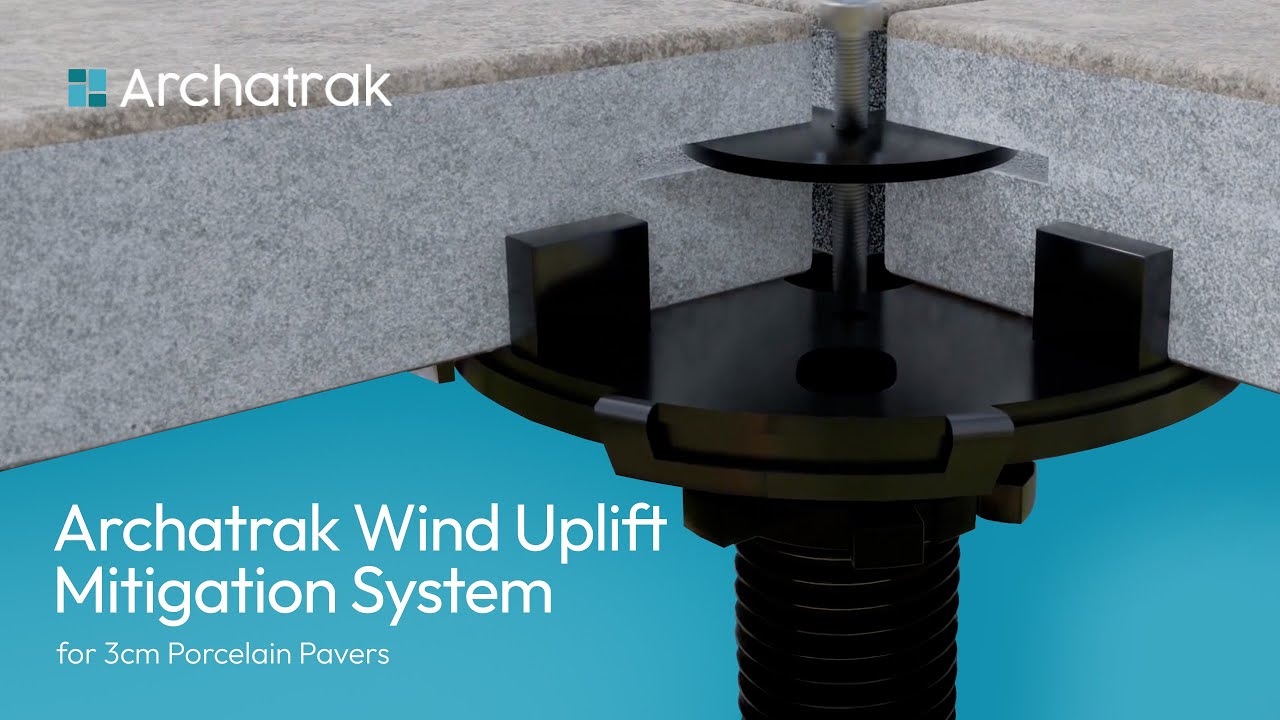
This wind uplift mitigation system utilizes thicker 3 cm porcelain pavers that can be kerf cut without compromising structural integrity. In this configuration, a small semi-circular kerf is cut at each corner of the paver to accept a steel hold-down washer, which is mechanically secured into the tapped head of an Archatrak Incendio steel pedestal. The result is a mechanically restrained paver assembly designed to resist wind uplift while maintaining full access to the space below the deck.
Because restraint is achieved through mechanical fastening rather than adhesive bonding, installation proceeds without cure-time delays, and individual pavers can be removed as needed for inspection, maintenance, or repair without disturbing the surrounding deck surface.
System components and tested performance:
- 3 cm porcelain pavers: Kerf cut at each corner to accept steel hold-down washers
- Mechanical restraint: Steel washers secured directly into tapped Incendio steel pedestal heads
- System configuration: Uses standard, unmodified pedestal and paver components
- Surface appearance: No visible fixing devices on the deck surface
- Testing standard: Tested in accordance with ASTM E330 for structural performance under uniform static air pressure difference
- Performance data: Wind uplift testing demonstrated an average failure pressure of 280 psf*
** A non-site-specific structural performance evaluation of the Archatrak wind uplift mitigation systems and test results was undertaken by Engineering Express, Boca Raton FL. who have certified the systems to resist wind pressures as stated in the certification document for roof top or at grade installations in accordance with design criteria, International Building Code (2015, 2018 & 2021), Florida Building Code 8th Edition (2023), ASCE 7-16/7-22 Load Combinations.
A copy of the certification document is available on request from Archatrak.
Certified Results for Resistance to Wind Uplift Pressure
A non-site-specific structural performance evaluation of the Archatrak wind uplift mitigation systems and the ASTM E330 test results was undertaken by Engineering Express, Boca Raton FL.
Both systems have been certified to resist the wind pressures as stated in the certification document for roof top or at grade installations in accordance with design criteria, International Building Code (2015, 2018 & 2021), Florida Building Code 8th Edition (2023), ASCE 7-16/7-22 Load Combinations.
A copy of the certification document is available on request from Archatrak. Email us at [email protected] or follow the button below.
Wind Tunnel Research Study on Uplift of 2cm Porcelain Pavers
Because limited research had been conducted on wind uplift behavior of porcelain pavers installed over pedestal-supported systems, or on the specific wind speeds at which uplift and blowoff could occur, Archatrak commissioned an independent wind tunnel study in 2014 at the Florida International University Wall of Wind (FIU WOW) facility.
The study investigated the wind speeds at which movement and ultimate blowoff of unrestrained porcelain pavers could occur under varying conditions, including wind angle, parapet height, and pedestal height. The results showed that:
- The most critical angle of incoming wind was 45°. Angles tested included 0°, 15°, 30°, and 45°.
- Blowoff wind speeds were approximately 10 mph higher when a 12″ parapet was present compared to conditions with no parapet. This result was consistent for both 8″ pedestal-supported pavers and pavers supported on 1/2″ pads.
- Blowoff wind speeds were approximately 30–40 mph higher for pavers installed on 1/2″ pads compared to pavers supported on 8″ pedestals.
- The most critical regions for blowoff were along the two sides of the test deck closest to the incoming wind. In nearly all tests, the first pavers to blow off were located in these zones, typically the 2nd or 3rd paver from the corner.
Blowoff wind speeds are shown below. Complete results from this wind uplift testing are available by downloading the full FIU Wall of Wind test report.
Critical Factors Influencing Wind Uplift in Pedestal-Supported Paver Systems
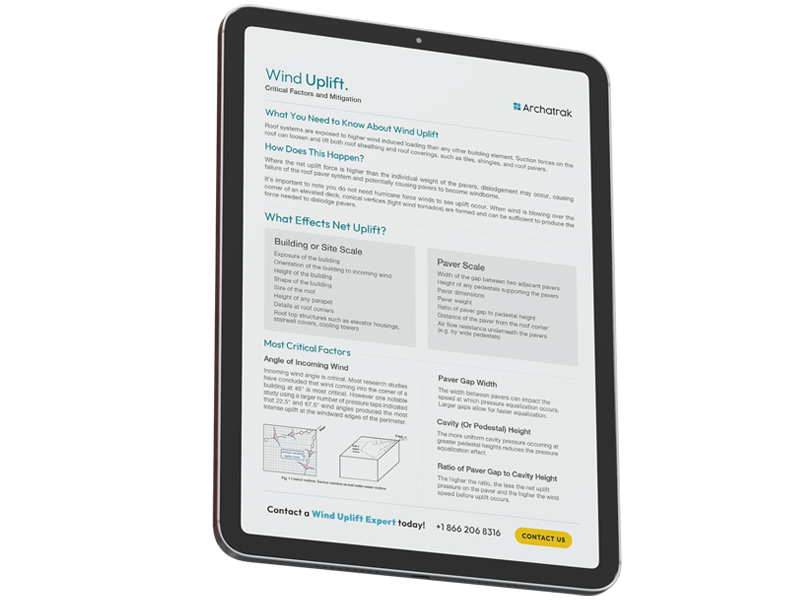
Wind uplift on rooftop paver systems results from interactions between building geometry, site exposure, and local deck conditions. Research has shown that uplift can occur well below hurricane-force winds due to localized pressure effects, particularly near roof perimeters where conical vortices can form. Understanding the primary factors influencing net uplift pressure is critical when evaluating wind risk and selecting appropriate mitigation strategies for pedestal-supported porcelain paver systems.
Building and site-scale factors:
- Building height, shape, orientation, and exposure
- Roof size and overall geometry
- Angle of incoming wind relative to the building
- Parapet height and configuration, including solid versus porous parapets
- Rooftop structures such as elevator overruns, stair enclosures and mechanical equipment
Paver system and local deck conditions:
- Paver weight, plan size, and distance from roof corners
- Pedestal height and cavity depth beneath the pavers
- Joint width between adjacent pavers
- Ratio of paver joint width to cavity height
- Airflow resistance beneath the pavers, influenced by pedestal geometry and spacing
Parapet Height Blow-off Speeds
8” High Pedestal
No Parapet: 90 MPH
12” Parapet: 110 MPH
½” Rubber Pads
No Parapet: 130 MPH
12” Parapet: 140 MPH
Wall of Wind testing available upon request.
FAQs
Frequently asked questions about wind uplift mitigation for commercial and residential roofdeck applications.
Wind uplift is the suction force created when wind flows over a roof and creates pressure differentials that can lift unrestrained pavers. Any paver installed on a rooftop, balcony, or exposed elevated deck without hold-down measures can be subject to uplift and, under the right conditions, become airborne.
Wind uplift risk is typically greatest near roof corners and along perimeter edges where wind effects concentrate. Archatrak’s guidance notes that the critical location for potential uplift failure is around 4 feet from roof corners, and risk is influenced by wind direction relative to the roof.
The most effective approach is to lock pavers together so they act as one interconnected array, rather than relying on individual pavers staying in place by weight alone. Archatrak notes that large-scale wind tunnel research indicates interconnected/locked systems are exceptionally effective, especially near exposed corners and along the perimeter.
Yes. Parapet height can significantly influence wind uplift forces on rooftop paver systems. Wind flowing over a roof can form rotating vortices near the perimeter that create suction forces capable of lifting loose pavers.
Research shows that very low parapets (up to about 6 inches) can actually increase uplift risk compared to having no parapet at all. As parapet height increases beyond this level, it generally provides greater resistance to wind uplift by disrupting wind vortices and reducing pressure differences across the deck surface.
Because parapet design is only one factor affecting uplift, rooftop deck systems should also consider building height, wind exposure, pedestal height, paver weight, and the use of mechanical hold-down systems when designing for wind resistance.
Related Systems
-
Non-Combustible Rooftop Decks
Class-A rated, 100% fireproof deck construction.
-
Wind Uplift Solutions for Pedestal and Paver Decks
Wind uplift solutions for pedestal supported pavers decks with 2cm and 3cm pavers.
-
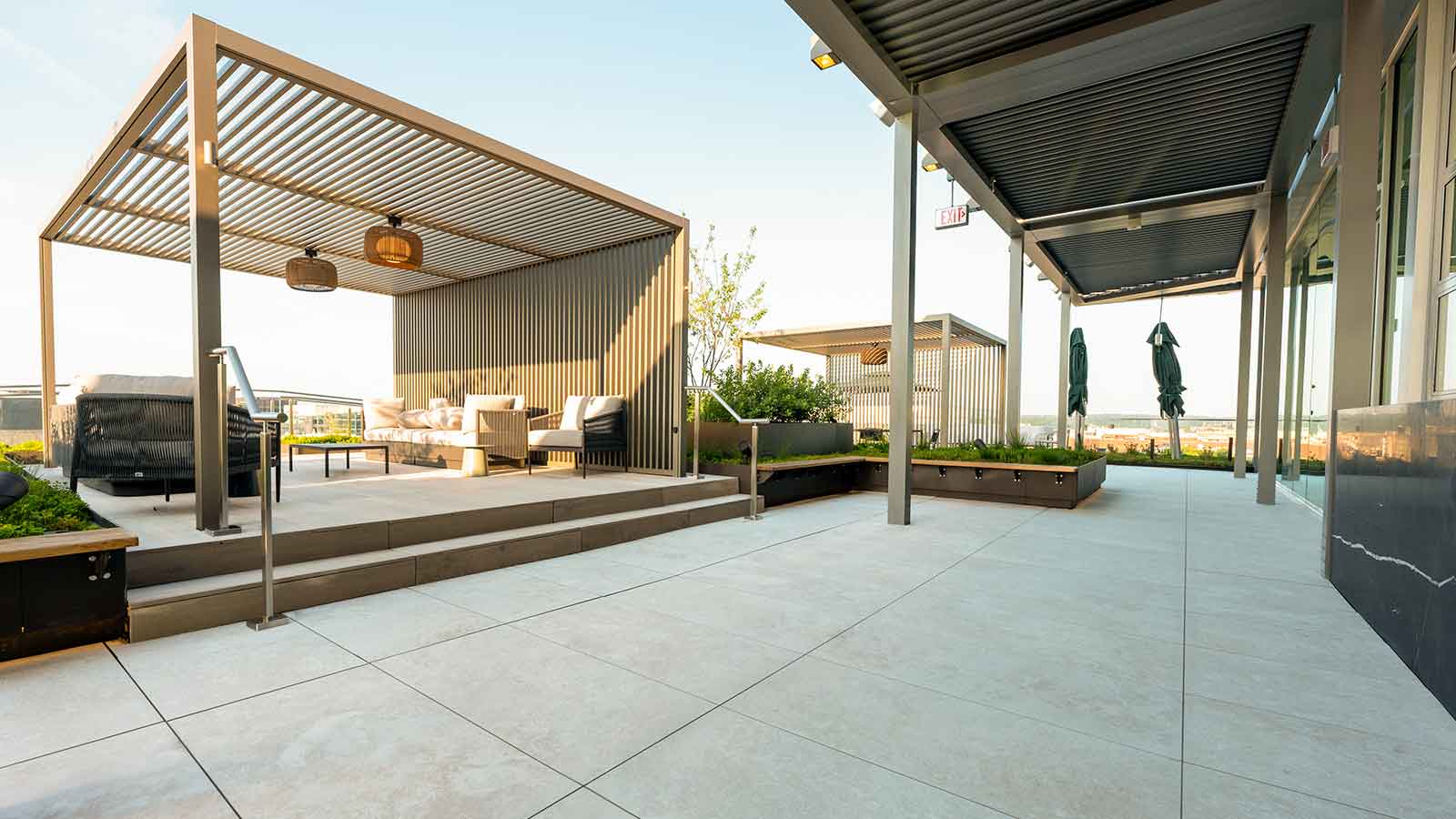
Roof Deck Pavers
Highly aesthetic and durable porcelain roof pavers in varying sizes and thicknesses.
-
Support for Elevated Green Roof Systems
Components to create simple and beautiful vegetated green roofs.
-
Elevated Artificial Turf Decks
FRP and pedestals for creating elevated artificial turf decks.
-
Heatizon Electric Paver Snow Melt System
Electric snowmelt system for elevated paver decks.