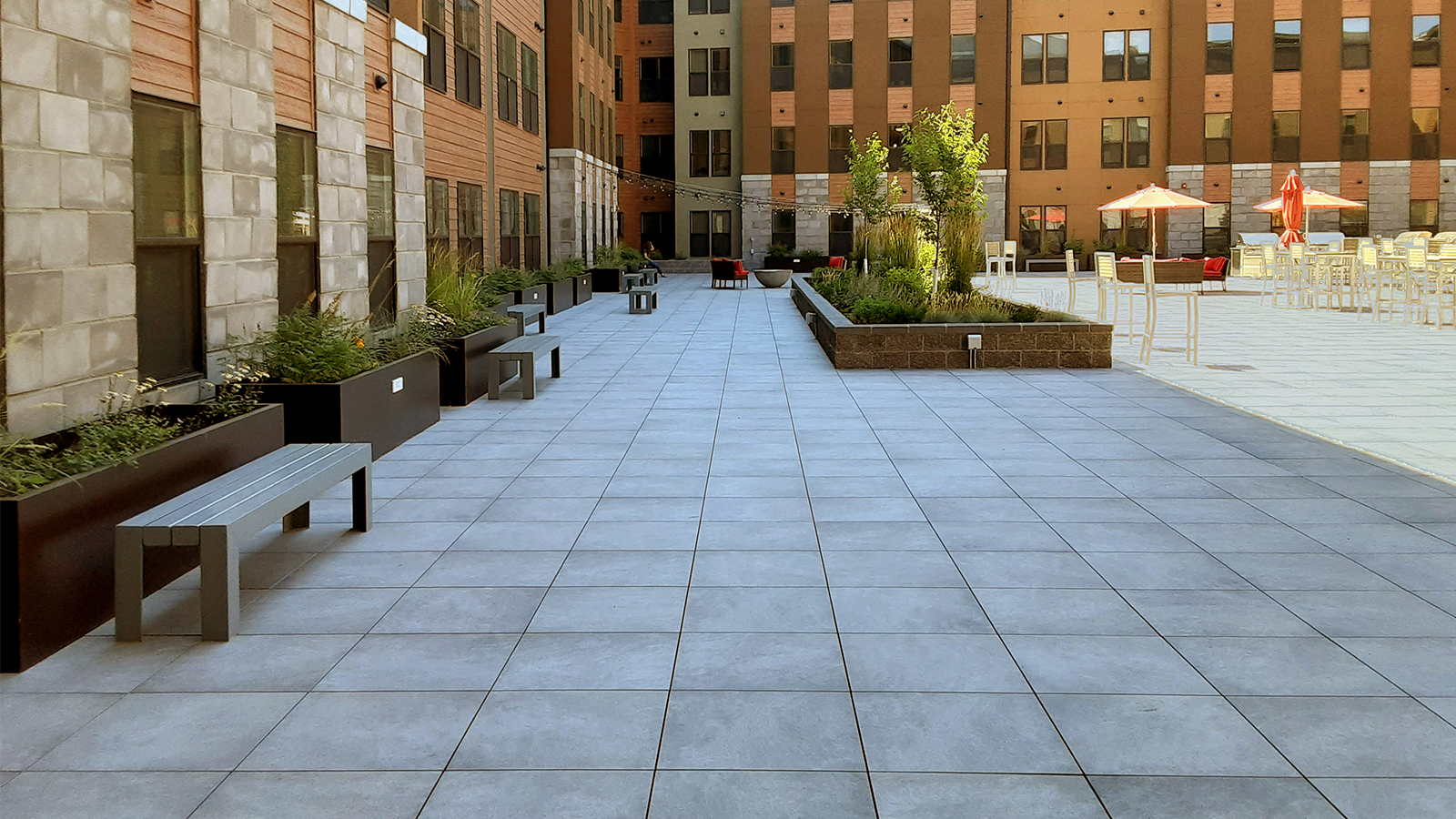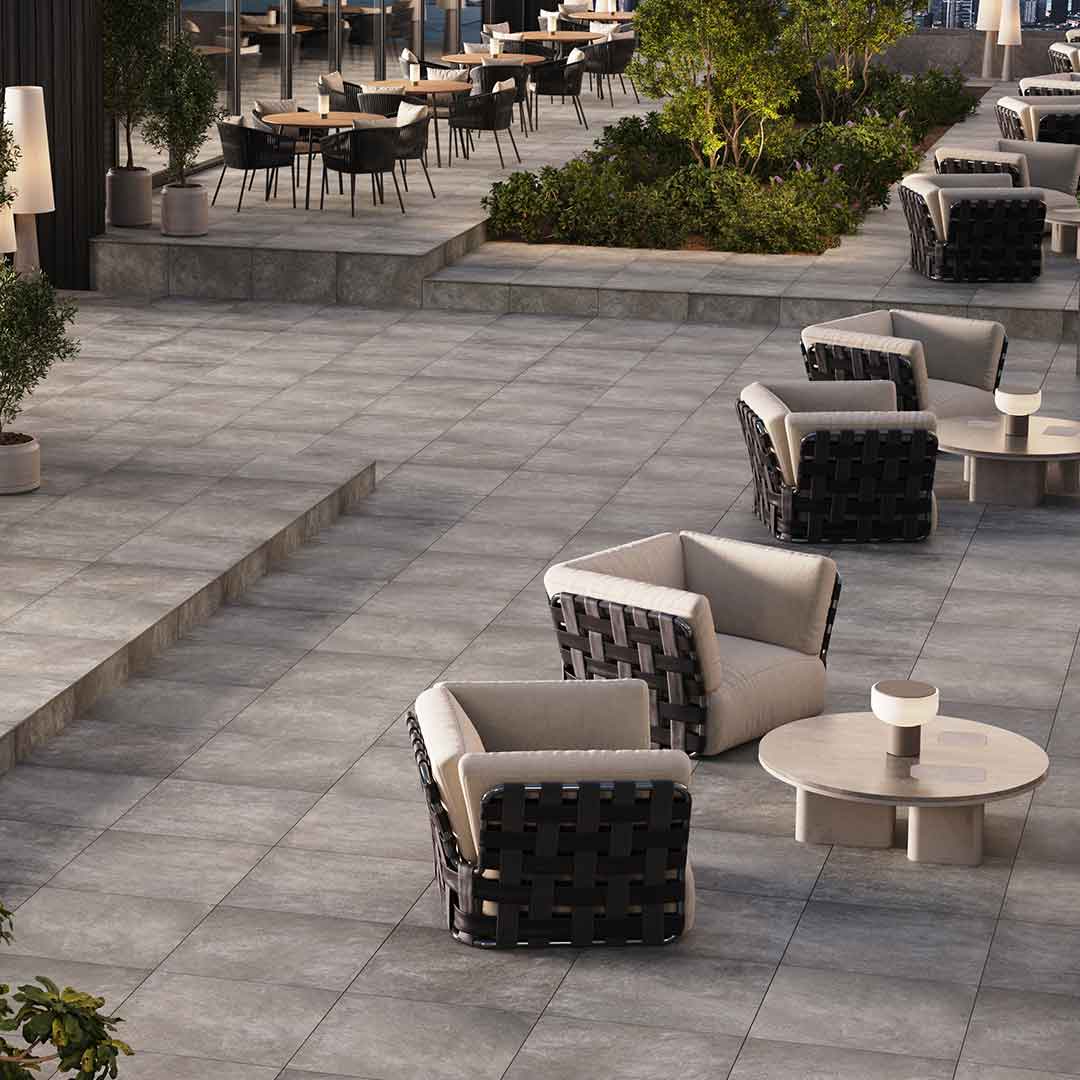
While Archatrak porcelain pavers are dense, rigid, and highly durable, they can still be vulnerable to damage from mishandling, careless treatment, or accidental impact. Heavy tools, furniture, or other hard objects dropped on the pavers can result in chipping, surface damage, cracking, or breakage.
In elevated deck applications where the risk of impact damage is higher, backing and protection systems on the underside of the pavers are recommended. This is particularly important at deck heights above 4” or in high-traffic commercial installations where dropped objects are more likely.
Archatrak offers multiple paver backing and protection options, including steel paver tray systems, FRP grating, and self-adhesive protection sheets, to support safe, durable elevated deck installations.
Paver backing and protection should be considered when:
- Deck elevations are greater than 4″ above the roof membrane or substrate
- Commercial or public rooftop environments present a higher likelihood of impact from dropped objects
- Protection of the waterproofing membrane from impact damage is a design priority
SpanSafe Galvanized Steel Paver Trays
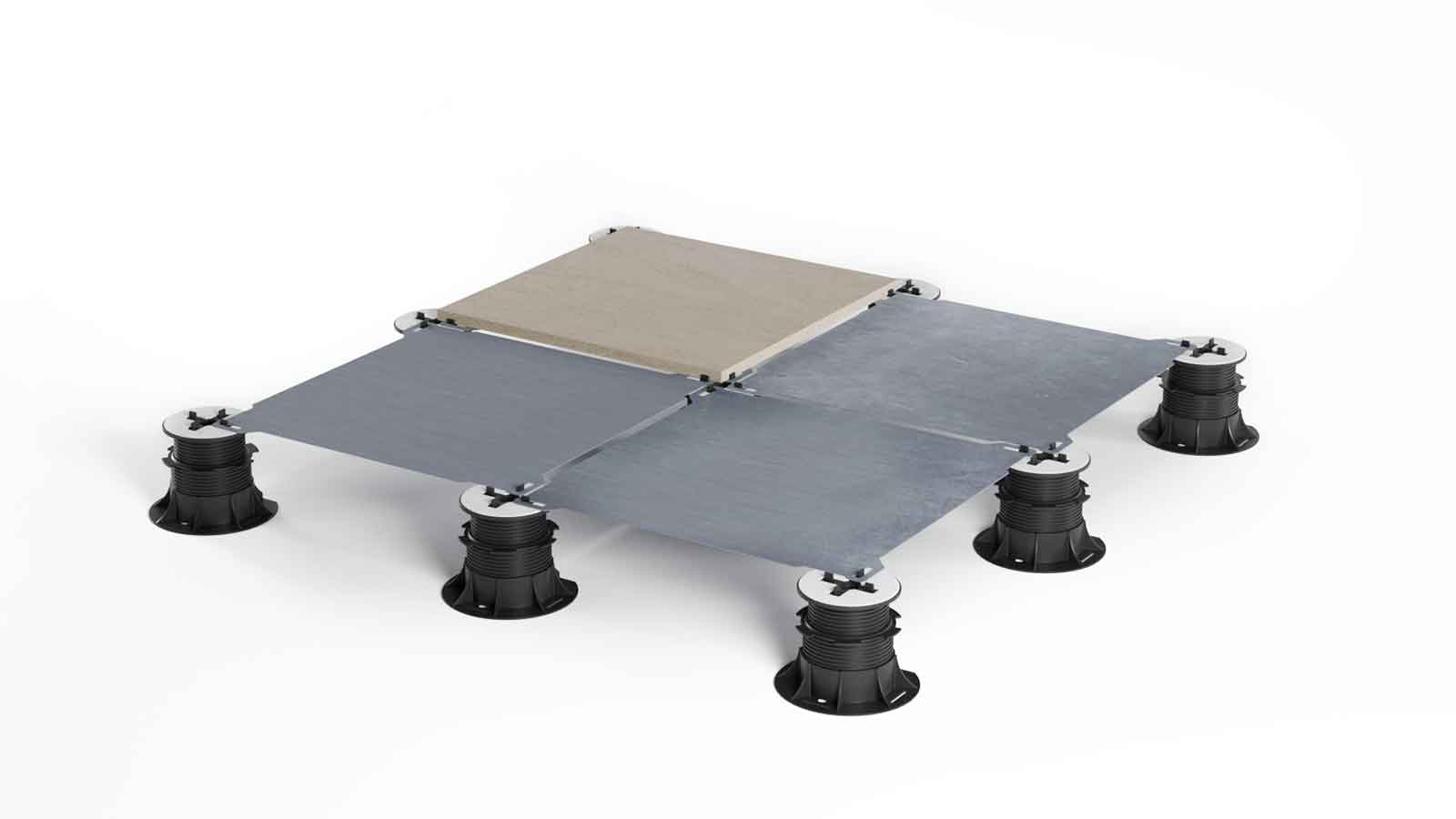
Archatrak SpanSafe galvanized steel trays provide underside protection for porcelain pavers installed on Premier or NM pedestal systems. Formed from 1 mm thick galvanized steel sheet, the trays feature 3/4″ high downturned edges on all four sides.
SpanSafe trays are sized to suit common porcelain paver formats, including nominal 24″ x 24″ and 48″ x 16″.
Installation notes:
- Pedestal positioning: Premier or NM pedestals should be set to approximate final location and height prior to placing trays
- Tray placement: Trays are placed so that each corner bears on a quadrant of the pedestal head
- Level check: Check and adjust level as each tray is installed to ensure a flat deck surface
- Paver installation: Porcelain pavers are installed directly over the trays and butted against the raised pedestal tabs
- Noise reduction: 1/16″ thick Archatrak rubber shims (ETE-LGH2) are recommended between trays and pavers at four-paver junctions to reduce noise and vibration
SpanTrak Fiberglass Grating Panels
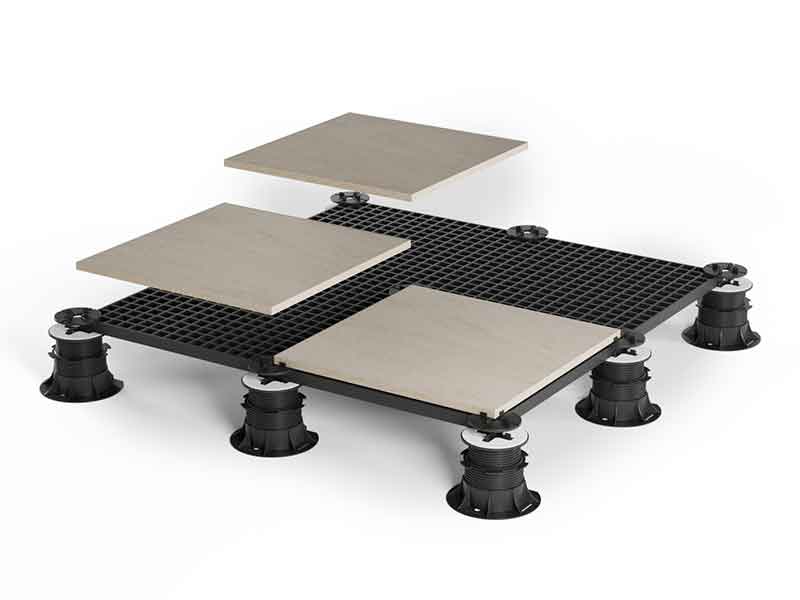
Archatrak SpanTrak FRP grating panels provide superior support with enhanced stability and risk mitigation, especially with narrow-format porcelain pavers . When installing porcelain pavers less than 16″ wide and longer than 24″, FRP grating panels typically provide an effective combination of support and breakage containment, while reducing the number of pedestals required.
SpanTrak MacroMesh fiberglass grating panels are supplied in a standard 4′ x 8′ format with a 1 1/2″ x 1 1/2″ aperture size, 1 1/4″ thickness, and a nominal weight of 3.0 lb per sq ft. Panels are manufactured using pure isophthalic resins with aluminum hydroxide filler to enhance flame retardancy and smoke suppression.
Installation notes:
- Pedestal layout: Panels are typically supported on pedestals spaced at approximately 24″ on center in both directions
- Panel placement: FRP grating panels are placed directly over the pedestals to create a continuous support surface
- Panel restraint: Adjacent panels can be secured at the edges using stainless steel C-clips to prevent movement
- Paver installation: Porcelain pavers are installed directly over the grating panels using 1/4″ thick Archatrak rubber support pads (ETE-PAD6) with integrated spacer tabs placed under each corner to maintain joint spacing and reduce noise transmission
PaverGuard Adhesive Pads
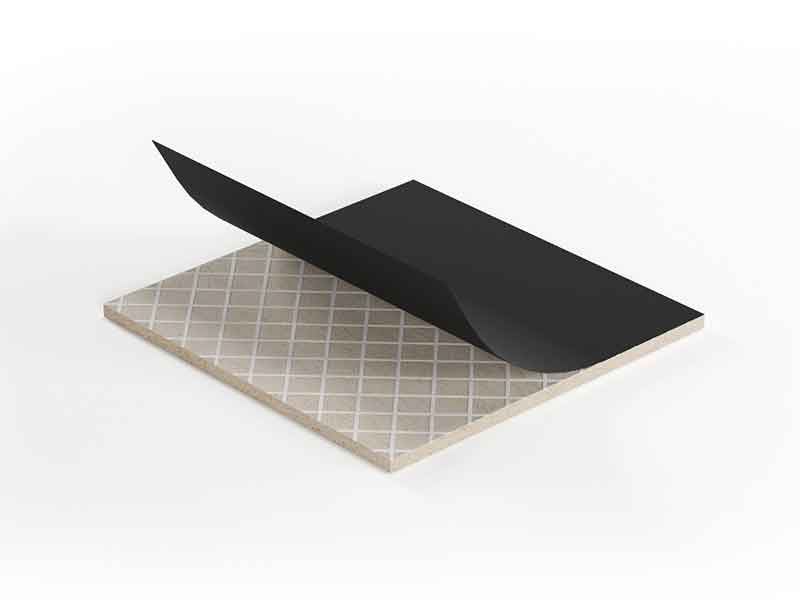
PaverGuard Adhesive Pads provide a lightweight, low-profile, self-adhesive backing option for porcelain pavers in elevated deck applications where additional protection is required. The sheets are flexible, fiberglass-reinforced, and pre-cut to match common porcelain paver sizes.
PaverGuard sheets are supplied pre-cut to suit nominal 24″ x 24″ and 16″ x 48″ porcelain pavers and are bonded directly to the underside of the paver prior to installation.
Installation notes:
- Surface preparation: Paver underside must be clean, dry, and free of dust or debris prior to application
- Primer: For best adhesion results primer should be used to help with effective adhesion. Ask our sales staff for the recommended primer type
- Sheet application: Protective backing is removed and the sheet is pressed firmly onto the underside of the paver, ensuring full contact and avoiding air bubbles
- Adhesion check: Adequate adhesion should be verified before paver installation
- Temperature limits: PaverGuard sheets should not be applied when ambient temperatures are below 32°F
- Cold-weather application: Gentle heating of the paver underside may improve adhesion in cold conditions. Application of a primer may be required in some situations.
FAQs
Frequently asked questions about plate and pad backing for porcelain pavers.
Break-through protection refers to safety systems installed beneath porcelain pavers on pedestal-supported decks to reduce the risk of injury if a paver cracks or breaks.
Although porcelain pavers are extremely durable, they can be damaged by accidental impacts such as dropped tools, furniture, or other heavy objects. When this occurs on an elevated deck, protection trays, plates, grating, or reinforced sheets can help prevent broken paver pieces from falling through the deck surface.
Archatrak offers several break-through protection options including steel trays, galvanized protection plates, fiberglass grating panels, and self-adhesive protection sheets.
Break-through protection is typically recommended for elevated pedestal installations, particularly when the deck surface is raised more than about 4 inches above the substrate or in areas where objects could be dropped onto the pavers.
It is commonly used on rooftop decks, terraces, and other commercial spaces where additional safety measures are appropriate if a paver becomes damaged during use.
If a porcelain paver cracks due to accidental impact, plate and pad backing systems help keep the broken paver pieces contained so they do not fall through the deck surface.
For example, steel protection plates installed beneath the pavers are designed to minimize collapse or fall-through of broken paver pieces, allowing someone standing on the paver to safely step away from the damaged area.
This helps reduce the risk of injury on elevated decks.
Related Systems
-
Wind Uplift Solutions for Pedestal and Paver Decks Draft
Wind uplift solutions for pedestal supported pavers decks with 2cm and 3cm pavers.
-
Support for Elevated Green Roof Systems
Components to create simple and beautiful vegetated green roofs.
-
Elevated Artificial Turf Decks
FRP and pedestals for creating elevated artificial turf decks.
-
Heatizon Electric Paver Snow Melt System
Electric snowmelt system for elevated paver decks.
-
Plate and Sheet Paver Backing
Additional paver support options and breakthrough protection.
-
Wind Uplift Solutions for Pedestal and Paver Decks
Wind uplift solutions for pedestal supported pavers decks with 2cm and 3cm pavers.