It’s becoming much more common to use rooftop areas as useful spaces to enjoy the views and the open air. But with most rooftop decks, you are normally not permitted to place any permanent materials over an existing waterproof membrane, so realistically the only means to get yourself a new deck would be to install some type of raised deck which does not rely on a system of wood or steel bearers. So how do you begin choosing deck materials?
Possibly the two most common options are snap-together decking tiles or concrete pavers supported by a pedestal support system. With the snap together tiles, the plastic mesh base permits water to easily drain away underneath due to the plastic ‘feet’ which rest on the membrane. A question that sometimes arises with these tiles is whether the plastic base can cause any damage to the waterproof membrane over time. Normally this shouldn’t be an issue because there are many small ‘feet’ on the underside of each tile so the load bearing on each one of these feet is quite small.
Nevertheless, the main issue with snap-together tiles is the fact that you can’t correct for the gradient. In other words, they basically follow the existing slope of the rooftop. Additionally they can’t be placed on a surface which is not smooth. Often with roof decks, there may be raised seams on the watertight membrane or perhaps some other small raised areas on the roof surface. If so, using snap-in-place patio tiles may not be a viable option for you since they need to be laid on a flat surface so the interlocking mechanism can hold the tiles tightly together and so the edges of the tiles do not protrude upwards and create a tripping hazard..
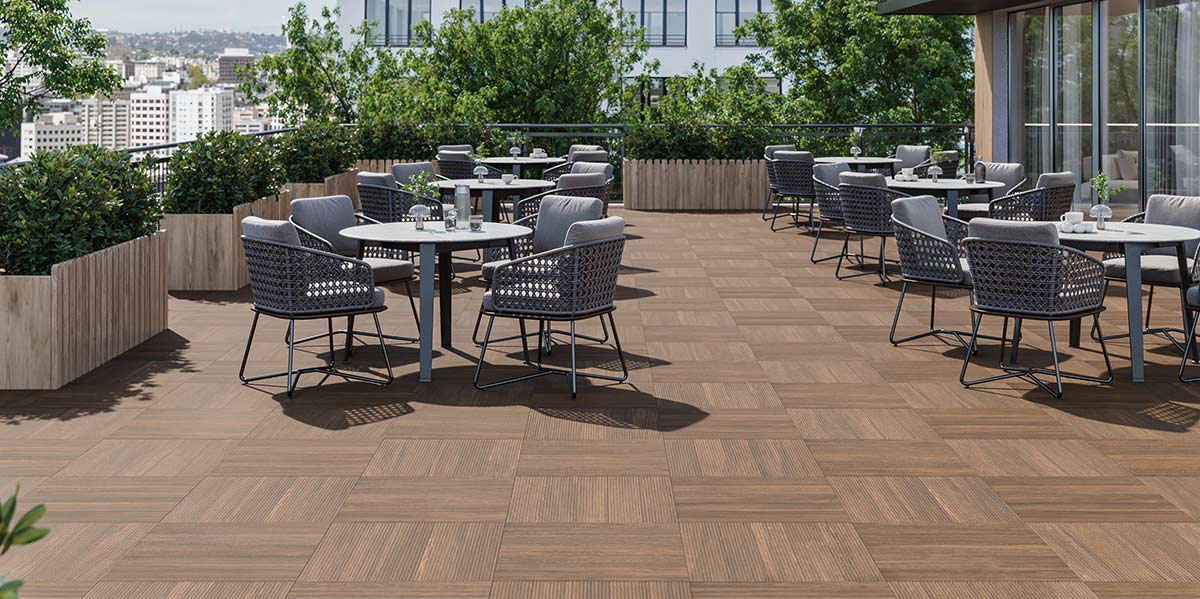
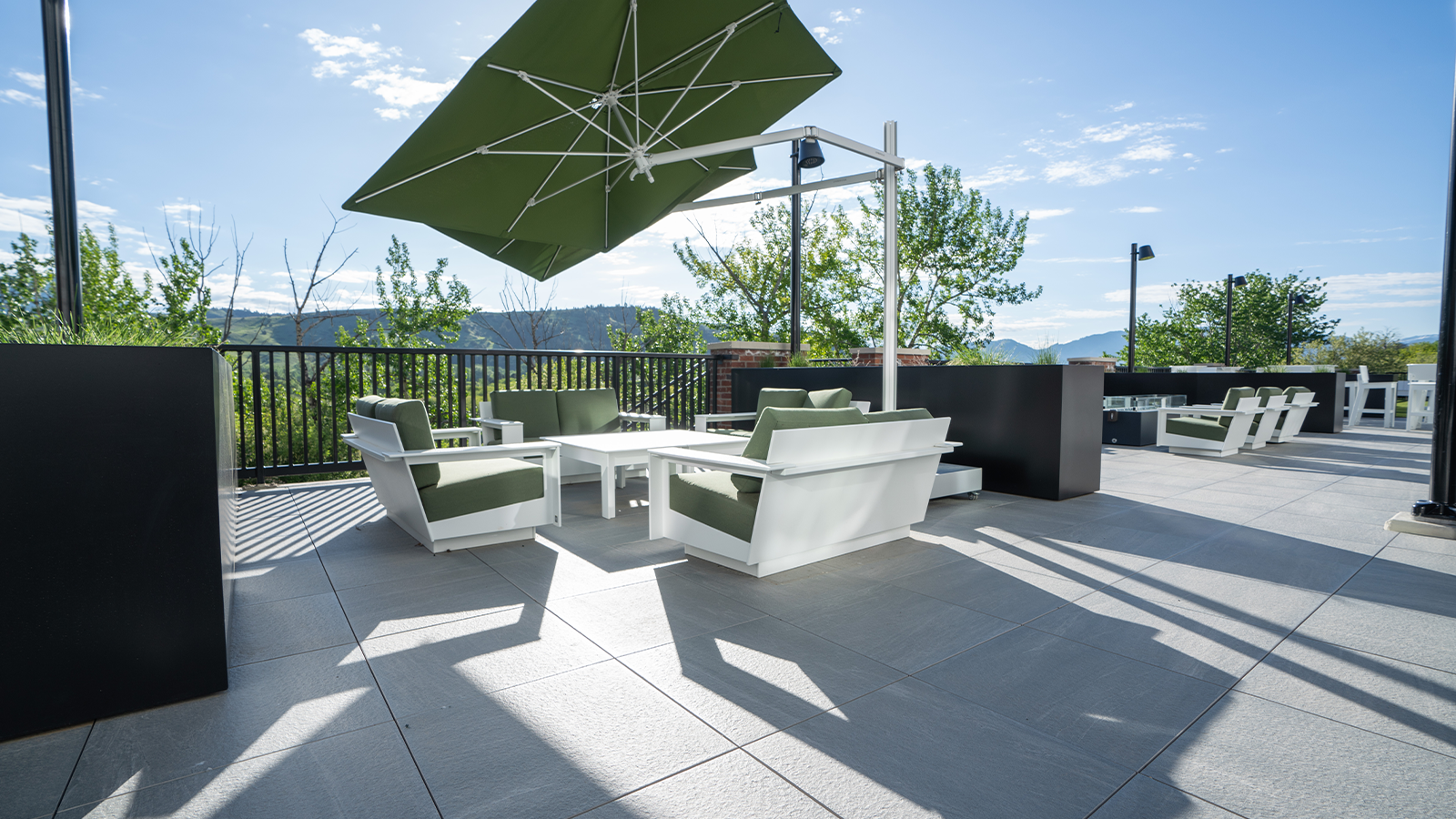
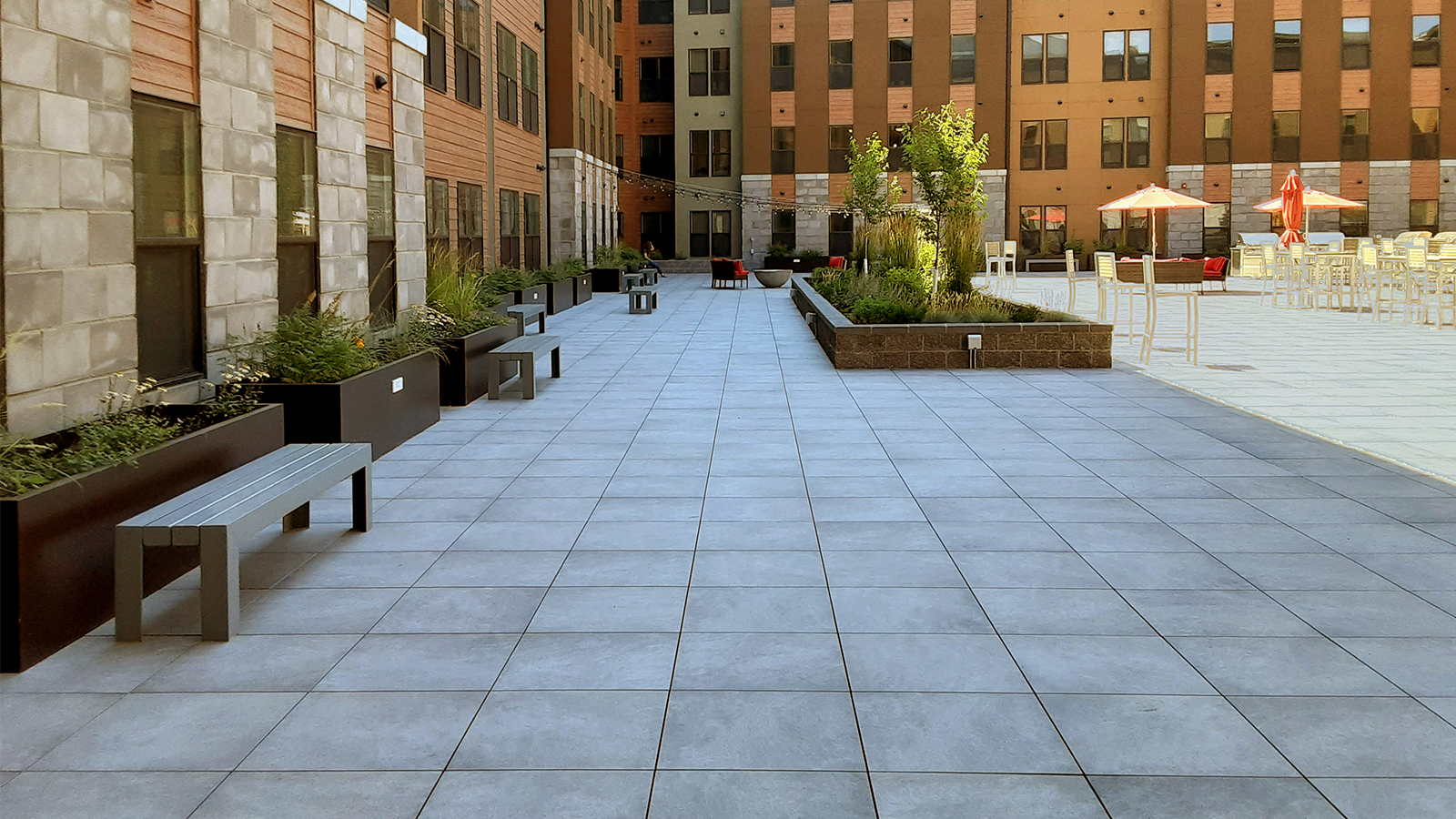
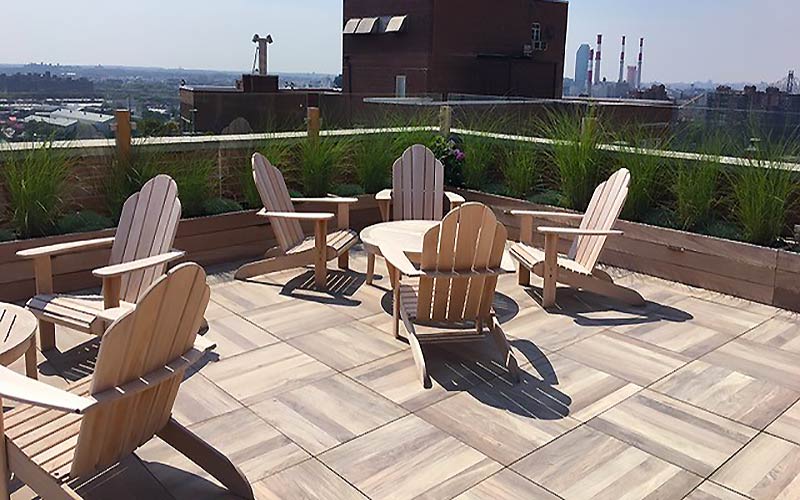
The other alternative is to use paving slabs with a pedestal support system. Traditionally, heavy concrete slabs have been used, but these days, a better option is to use structurally strong, but lighter weight ¾” thick porcelain pavers. These pavers are now available in an incredible variety of colors and styles including stone, wood, cement and rustic looks, impossible to achieve with concrete pavers. And porcelain offers the benefit of being almost totally nonporous, meaning that not merely does it not absorb water, which is often an issue in rather cold areas where freeze/thaw might be an issue, but the pavers are extremely stain resistant. Compared with a wood paver or a wood deck, they’re also completely fireproof, they won’t fade or change color in the sunlight, they won’t warp or twist, won’t decay or suffer insect attack and resist the growth of mold and mildew.
Although a pedestal paver deck might be somewhat more expensive than an interlocking tile surface, it does mean you can have perfectly level deck over a sloping surface, which will typically be the case with a rooftop deck. The pedestal supports are adjusted up or down by screwing the central column. With the Eterno pedestal support system you can even make adjustments to the paver height after installation with a special tool that slots into the head of the pedestal at the point where the corners of 4 pavers meet on the pedestal head.
If you only need to raise the deck by a small amount to compensate for slope across the deck, you would normally use stackable fixed height supports.
Fixed height paver supports are produced in both rubber and plastic. The rubber supports are typically a better choice, not only because they offer superior sound absorption and shock protection, but they also provide enhanced slip resistance between the bottom surface of the pedestal support and the base surface as well as between the paver and the top of the support itself. This is useful because generally with a fixed height pedestal system you need to install a restraining barrier at outside edges of the deck to stop any sideways movement of the pavers. But for low height applications in most residential applications, the frictional properties of the rubber pads may be sufficient to avoid the need for a restraining barrier.