
FRP Grating for Boardwalk Decking & Pathways
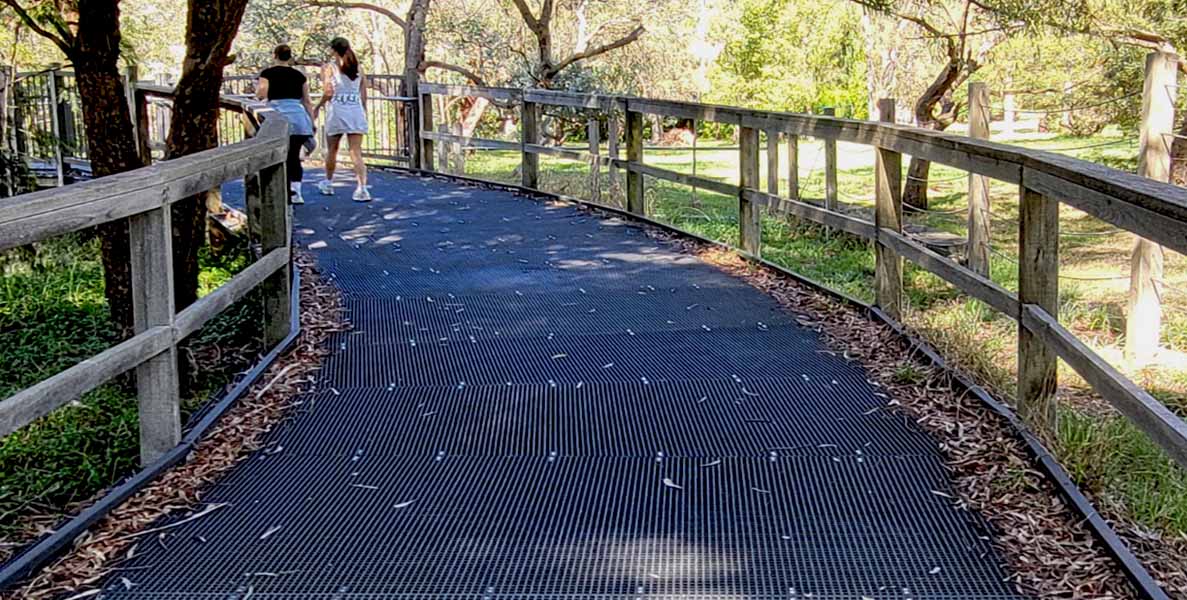
Unmatched combination of longevity and strength
In almost all respects, Fiberglass Reinforced Plastic (FRP) grating stands out as the superior choice for boardwalk decking, offering significant advantages over traditional materials such as softwood, hardwood, steel, composite wood, and precast concrete.
In terms of durability, safety, and longevity in particular, FRP grating is unmatched, making it especially well-suited for use in remote and environmentally sensitive areas including wetlands boardwalks where the ease of installation, minimal maintenance requirements, and extended lifespan are essential for building sustainable and functional boardwalks.
Proven durability & reliability in the most extreme conditions
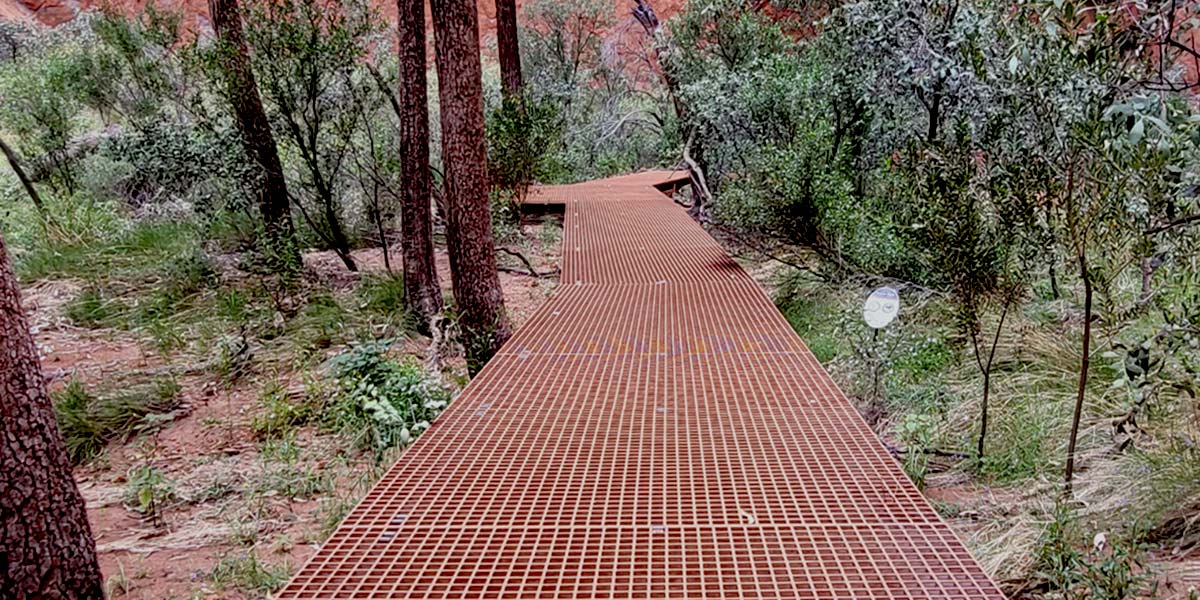
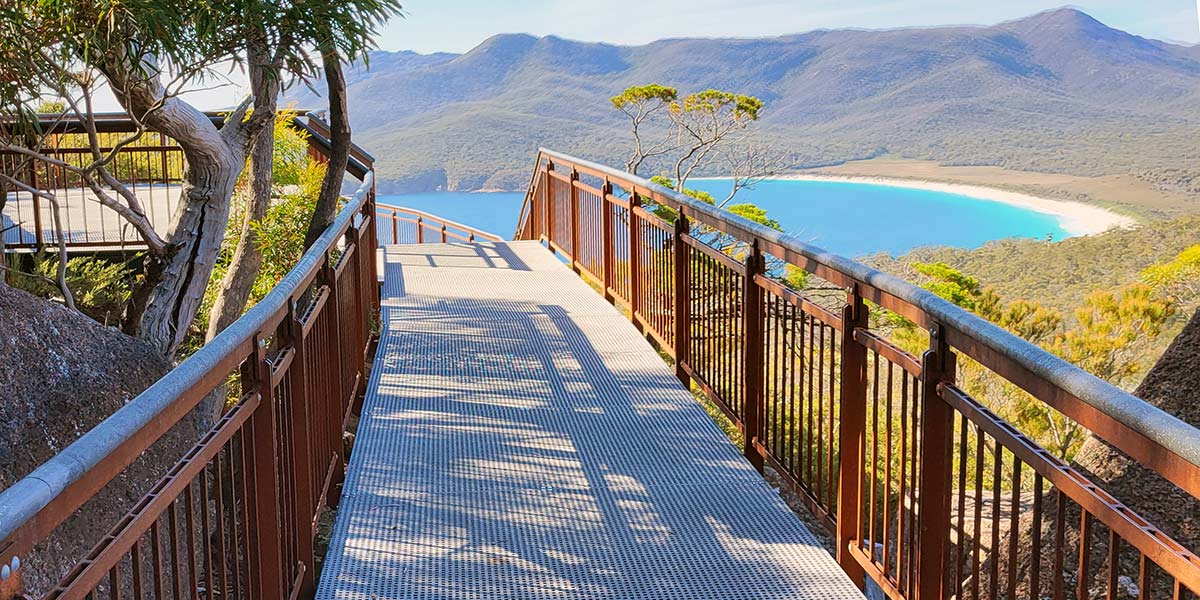
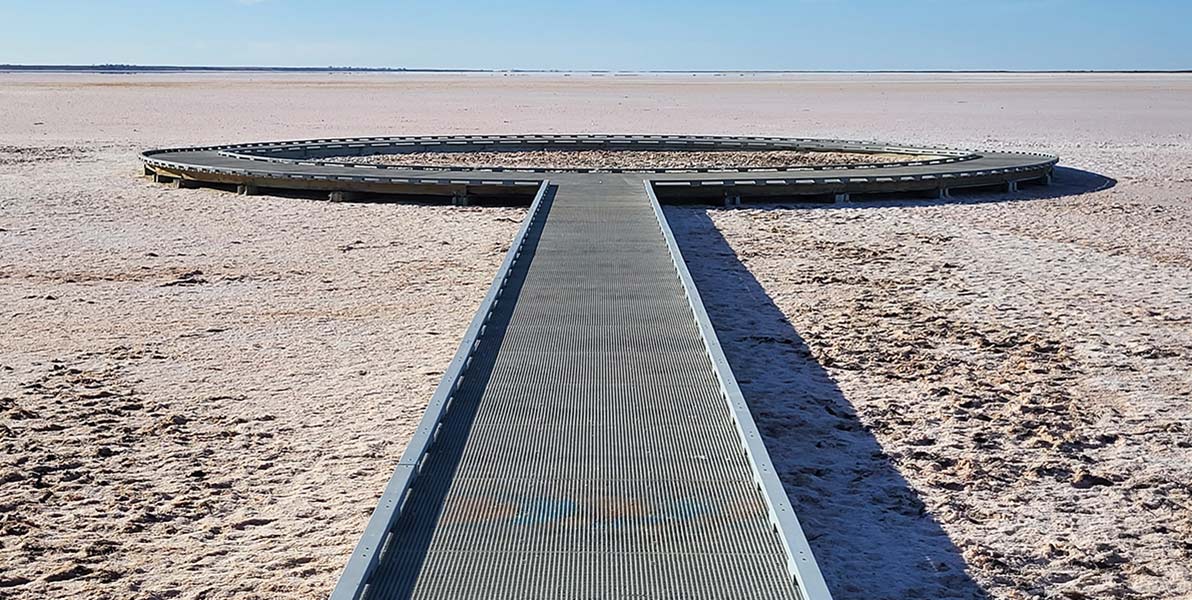
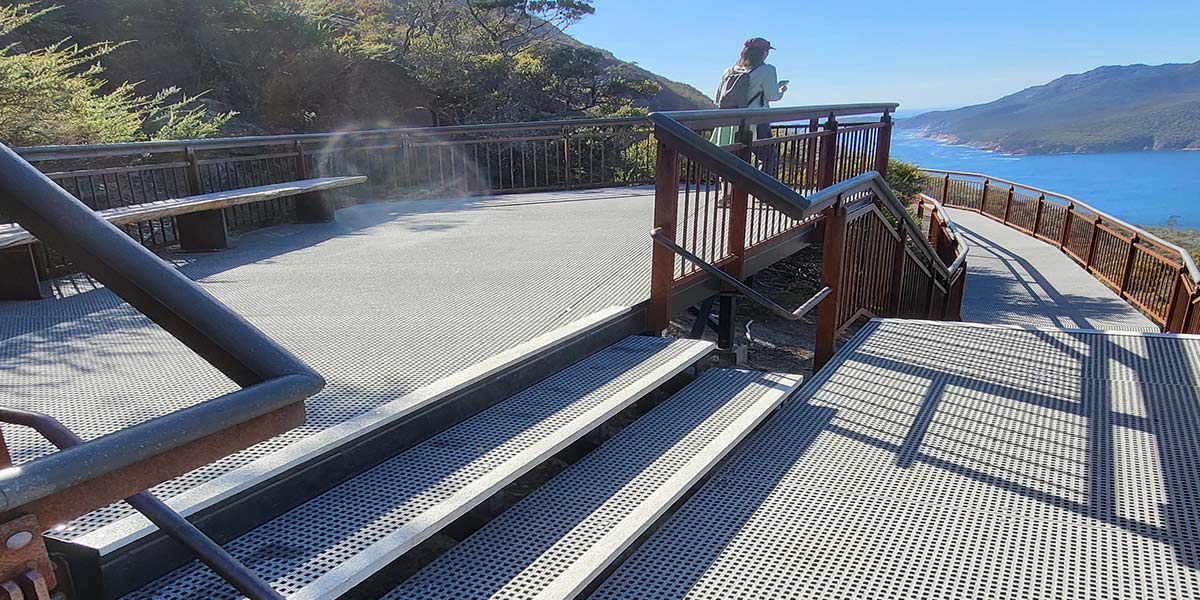
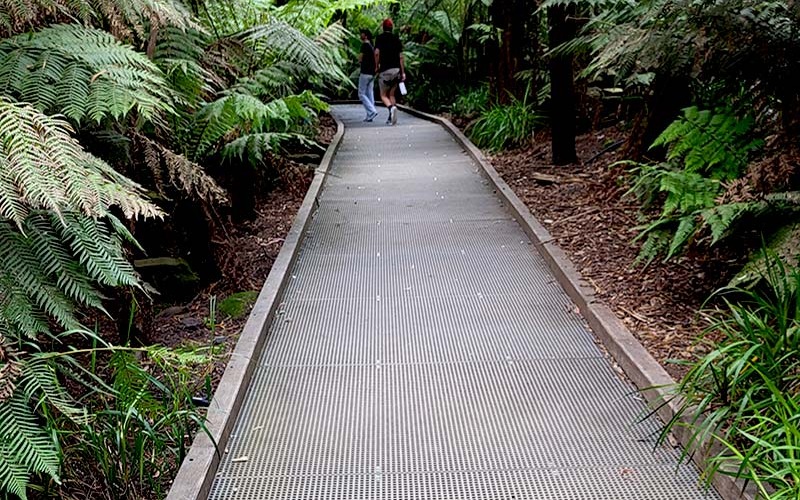
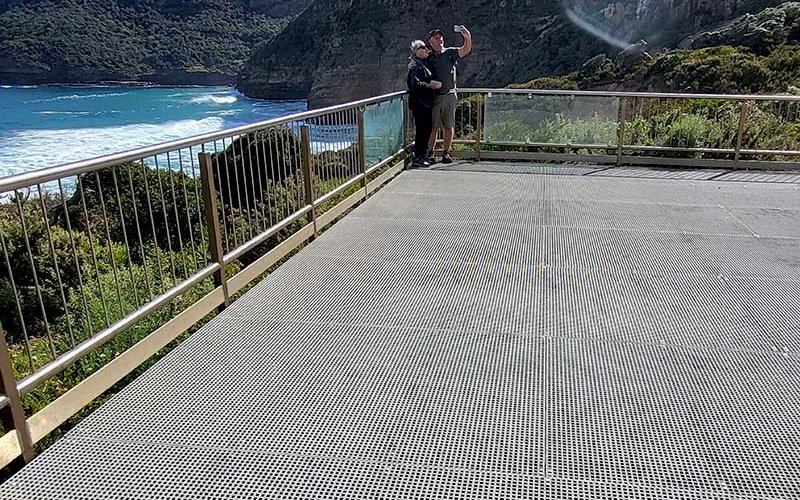
In countries such as Australia, FRP grating has almost universally replaced all other decking material for boardwalks, over the past few decades. From the scorching desert pathways circling Uluru (Ayers Rock) to the remote coastal walkways in Southern Tasmania lashed by the frigid waters of the Southern Ocean, FRP boardwalks provide the safest, most stable and durable surfaces for withstanding the constant streams of daily visitors, in all weather conditions, maintenance free.
All Archatrak ‘SpanTrak’ grating panels for exterior use are manufactured exclusively with pure isophthalic resins with UV additives to provide maximum resistance against degradation under all climatic and location specific conditions.
Superior pedestrian safety
Our ‘SpanTrak’ FRP grating panels for boardwalk decking are supplied with a gritted surface which provide unmatched slip resistance with all types of footwear, in all weather conditions, even in drenching rain, icy or severe Winter conditions. Furthermore, in such conditions, the open nature of the grating panels restricts the build up of ice and snow, which causes so many problems with solid surface boardwalk decking.
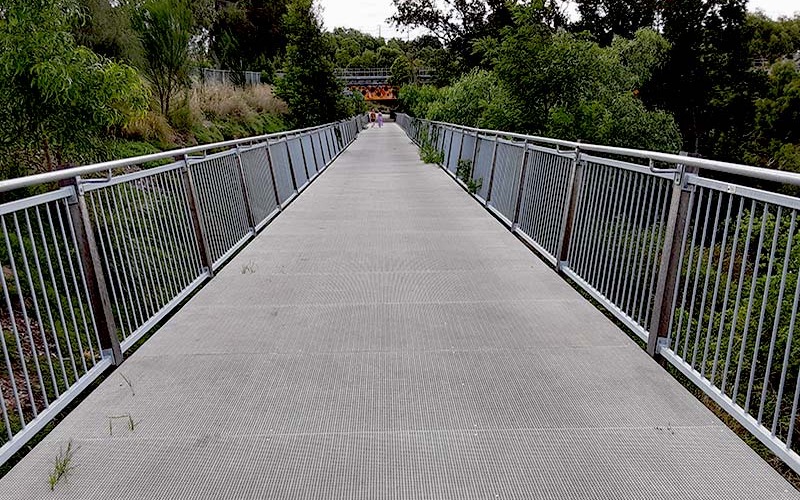
Cyclists in particular prefer FRP grating on cycle paths since they know it’s practically impossible for wheels to slip or slide on gritted FRP grating in comparison with wood which can be dangerous when icy or wet and covered with moss or mildew.
Enhanced comfort for pedestrians and wheelchair users
Because FRP gratings can deflect slightly under load, they can feel more comfortable underfoot compared with a solid surface like wood or steel. And the broad, flat surface offers a much smoother and even surface for wheelchairs, bicycles and scooters than parallel deck boards.
Excellent fire resistance
‘SpanTrak’ FRP grating panels are manufactured exclusively with Type-I Isophthalic resins combined with Aluminum Hydroxide filler (not Calcium Carbonate) giving results for smoke developed and spread of flame index that fall well within the classification for Class 1 or A fire resistance rating when tested in accordance with ASTM E84. Only steel or concrete boardwalk material can match this rating.
Lowest maintenance decking material
In remote locations and wetlands boardwalks in particular, you want a boardwalk you can rely on, year after year. Wood can decay or suffer insect attack, boards can twist and warp, steel can rust and collapse, creating safety hazards for walkers. “SpanTrak’ FRP grating panels are built for maximum durability with very little need for regular maintenance or constant inspection.
Lower environmental impact
In environmentally sensitive locations like wetlands or cold alpine locations, where boardwalks are used to protect the vegetation from foot traffic, the open grid structure of ‘SpanTrak’ FRP boardwalk gratings allows both sunlight and rainwater to reach the vegetation virtually unimpeded. In addition, ‘SpanTrak’ FRP boardwalk decking panels can be supplied in colors chosen to blend in with the existing environment, reducing the visual impact of boardwalks and enhancing visitor experience.
Unlike pressure treated wood decking, you also avoid all concerns about leaching of preservative chemicals.
Faster, simpler construction
Since ‘SpanTrak’ FRP boardwalk decking is typically supplied in 4’ x 8’ panels which generally only need fixing to the boardwalk support structure at 24” intervals, FRP grating panels are much quicker to install than wood planks. Even in comparison with steel grating which is up to 4 times as heavy, FRP panels can be easily cut with a power saw, while steel grating must generally be prefabricated to fit the precise location.
Aesthetic appeal
While the perhaps the somewhat more ‘industrial’ look of ‘SpanTrak’ fiberglass decking may not appeal to all tastes, its more modern, uniform, consistent color can be more appropriate in many situations. And the ability to specify a color for the fiberglass decking that will blend into the environment can significantly reduce the visual impact in regions where there is trade off between the need for a boardwalk but a requirement for minimal impact on the local environment.
Key Benefits of Archatrak "SpanTrak' FRP Grating for Boardwalk Decking
 No loose, dangerous nails or screws
No rusting or corrosion
Excellent slip resistance in wet or dry conditions
Withstands severe marine environments
Highly resistant to moss and mildew growth
Practically zero maintenance
Open mesh allows light to reach vegetation below
No leaching of preservative chemicals in wetlands boardwalks
Class A fire resistant ASTM E84
Lightweight and easily cut in field
Can be colored to blend unobtrusively into the landscape
No loose, dangerous nails or screws
No rusting or corrosion
Excellent slip resistance in wet or dry conditions
Withstands severe marine environments
Highly resistant to moss and mildew growth
Practically zero maintenance
Open mesh allows light to reach vegetation below
No leaching of preservative chemicals in wetlands boardwalks
Class A fire resistant ASTM E84
Lightweight and easily cut in field
Can be colored to blend unobtrusively into the landscape
FAQ
How does ‘SpanTrak’ FRP decking compare with other boardwalk decking materials
See our blog post for a detailed evaluation of the pros and cons of different boardwalk materials – FRP, wood, steel, composite wood, and concrete – evaluating them on critical factors such as strength, slip resistance, durability, safety, environmental impact of wetlands boardwalks, ease of construction, cost, aesthetic appeal, and long-term maintenance. For a more in-depth look, with images of a wide range of boardwalk decking applications using FRP grating, download our SpanTrak FRP Boardwalk Decking brochure.
Can you use FRP grate panels on curved boardwalks?
Certainly. Most boardwalks will have railings that are constructed in straight sections and with curved boardwalks each adjoining section will then be angled to create the required curve. So in this case the outer edge of the fiberglass decking panel is parallel to the railings and the panel is cut at equal angles on both sides to accommodate the angle, making sure the primary load bars match up when panels are joined.
How do you attach FRP grate panels to steel support structures?
There’s no need to drill holes for any fixings. Steel clips are available which clamp the panels to ‘I’ beams.
Is FRP fiberglass decking safe with high heeled shoes?
While our normal recommendation for boardwalks is our SpanTrak ‘MidiMesh’ panels which have ½” apertures on the grid, our ‘MiniMesh’ panels have just ¼” wide apertures so can be used for locations where pedestrians with high heels may frequently visit.
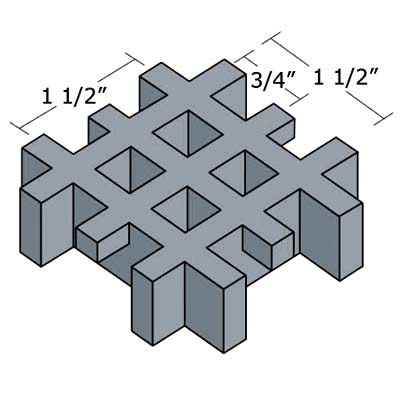
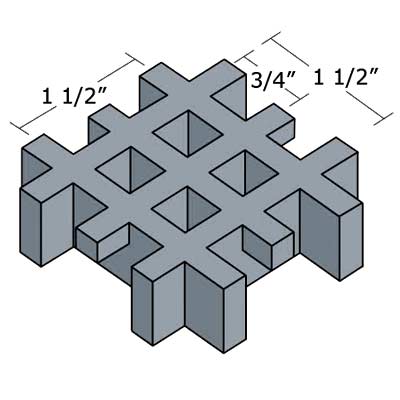
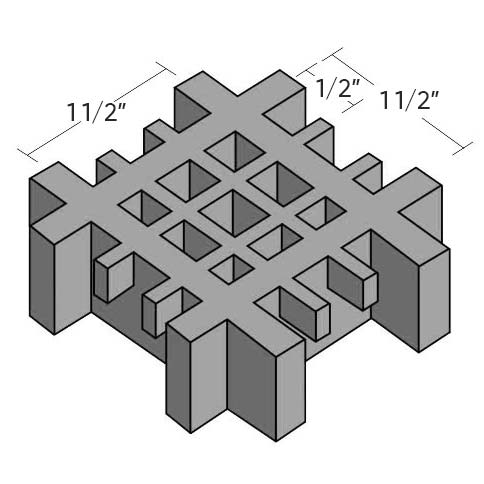
For pedestrian pathways and boardwalk decks, we typically recommend our ‘SpanTrak MidiMesh’ grate panels with 1 1/2″ x 1 1/2″ spacing between primary load bars and a secondary load bar ½” deep between the primary load bars, supplied with a gritted anti-slip finish and in dark grey color. Other sizes and colors can be supplied on special order. This specification provides very good foot coverage, safety for high heel shoe traffic and a smooth rolling surface for wheelchairs, carts, bicycles, scooters etc.
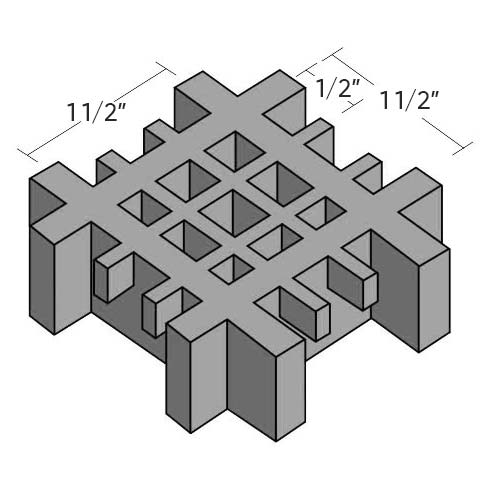
The slightly higher cost ‘MiniMesh’ grating panels which incorporates two additional secondary load bars between the primary load bars may be used where an exceptionally smooth rolling surface for the boardwalk deck is desired.
‘MidiMesh’ has an aperture size of 1/2″ x 1/2 compared with 1/4″ x 1/4″ for the ‘MiniMesh’ option.
Typically, 1 1/4″ thick fiberglass decking is used for boardwalk decking where bearers do not exceed 24″ on center, but for resurfacing existing wood pedestrian bridges or elevated walkways, 1″ thick grating may be used. A slight spongy feeling may be noticeable with thinner panels and where support bearers are placed further apart.
The standard size of ‘SpanTrak’ grate panels is 4′ x 8′ but other sizes can be supplied on special order.
A gritted surface is normally specified for boardwalk decking since this provides excellent slip resistance even in wet weather, although for beach front applications, the grit finish can be rather harsh on bare feet, so fiberglass decking panels with a meniscus surface finish may be preferable in such locations.
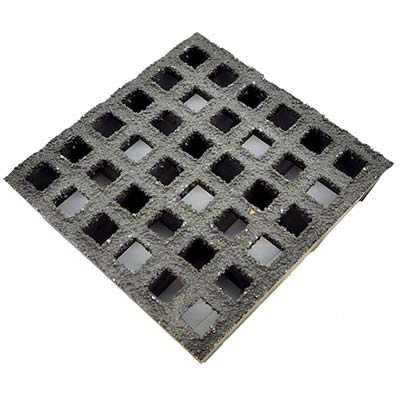
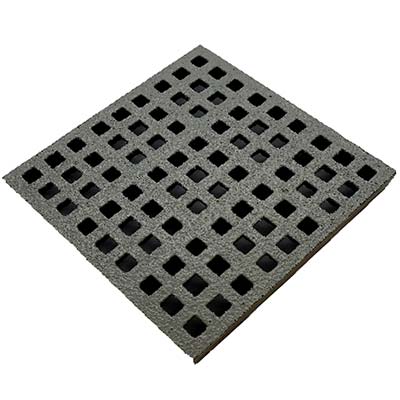
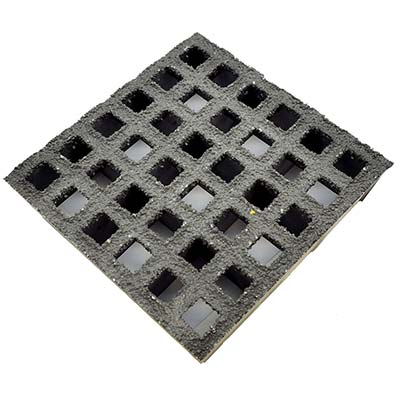
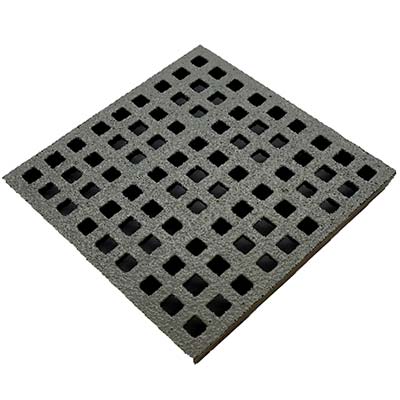
For boardwalk decking applications, Archatrak only supplies gratings manufactured with pure isophthalic resins and not lower cost polyester resins which do not offer sufficient long-term durability in harsh exterior conditions.
All our fiberglass grate panels use aluminum hydroxide filler (not calcium carbonate) for maximum fire resistance (flame retardant and smoke suppression) and contain UV stabilizers.
Archatrak ‘MidiMesh’
Thickness: 1 1/4″
Primary load bars: 1 1/2″ x 1 1/2″ on center
Secondary load bars: single bar between primary bars – 1/2″ deep
Mesh aperture: 1/2″ x 1/2″
Surface: anti-slip grit embedded in resin
Weight: 3.7 lb/sq.ft.
Archatrak ‘MiniMesh’
Thickness: 1 1/4″
Primary load bars: 1 1/2″ x 1 1/2″ on center
Secondary load bars: two bars between primary bars – 1/2″ deep
Mesh aperture: 1/4″ x 1/4″
Surface: anti-slip grit embedded in resin
Weight: 4.5 lb/sq.ft.
Fiberglass grate panels for boardwalk decking applications are normally fixed to support bearers with max. span of 48″ (depending on the thickness of the fiberglass panel and anticipated loadings) using stainless steel ‘M’ clips inserted in the grating apertures, with a minimum of four clips per panel. ‘L’ clips are generally not recommended as they don’t have the same strength as ‘M’ clips.
Where necessary, adjacent panels can be joined at the edges by means of stainless steel ‘C’ clips.
Since the aperture size of ‘MicroMesh’ panels is only 1/4″ x 1/4″, these panels are typically fixed to bearers with stainless steel screws or bolts with a 1/2″ diam.(min) head and a 6-lobe (Torx or equiv.) drive. A diamond cone drill with no pilot drill can be used to countersink the screws so the screw heads sit flush with the surface of the panels.
Where panels are installed over steel ‘I’ or ‘H’ beams and it is difficult to drill through the beams, hold down clips with an extended base plate may be used.
Where a change in direction is required on a boardwalk, panels can be cut at an angle, taking care to ensure adjacent panels are cut at the same angle so the load bars match up when panels are joined.
See our FRP installation page for further details.


Other Application Examples

Downloads
 Archatrak FRP Grating Panels GuideSpec 06 74 13
Filesize: 34709b
Archatrak FRP Grating Panels GuideSpec 06 74 13
Filesize: 34709b
 FRP Grating
Filesize: 4207347b
FRP Grating
Filesize: 4207347b
 Archatrak FRP Grating MidiMesh - CAD drawings
Filesize: 235605b
Archatrak FRP Grating MacroMesh - CAD drawings
Filesize: 223883b
SpanTrak For Boardwalks Brochure
Filesize: 3308710b
FRP Fire Test ASTME84 Anon
Filesize: 2167037b
Archatrak FRP Grating Deflection Chart
Filesize: 2336182b
Archatrak FRP Grating MidiMesh - CAD drawings
Filesize: 235605b
Archatrak FRP Grating MacroMesh - CAD drawings
Filesize: 223883b
SpanTrak For Boardwalks Brochure
Filesize: 3308710b
FRP Fire Test ASTME84 Anon
Filesize: 2167037b
Archatrak FRP Grating Deflection Chart
Filesize: 2336182b