
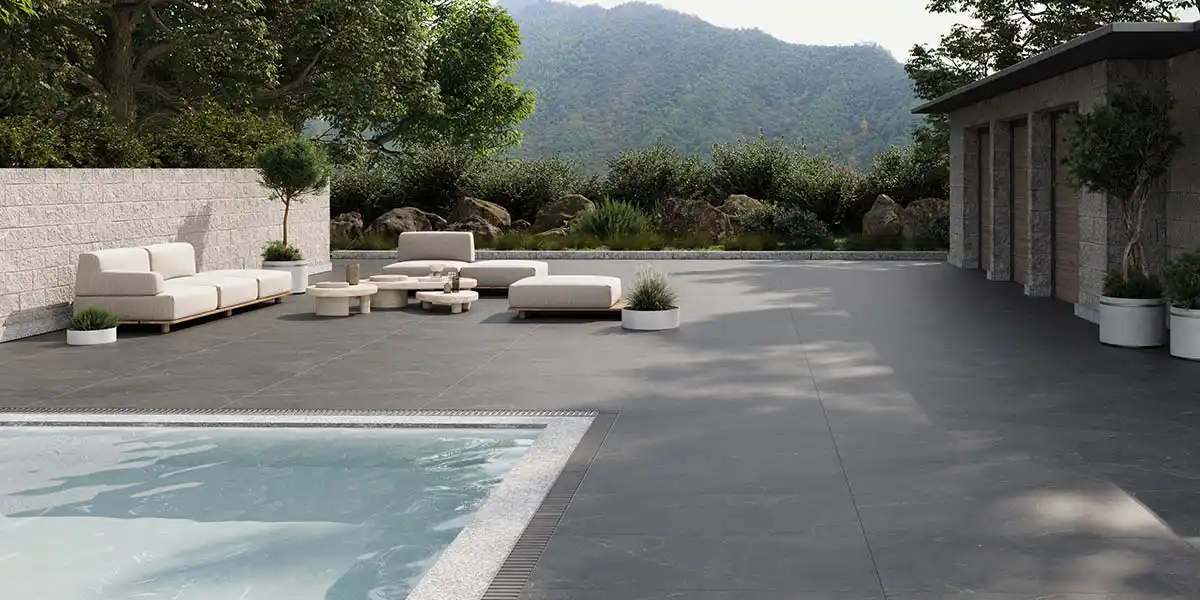
When deciding between porcelain and concrete pavers, the choice is more than just a matter of aesthetics — it’s about finding the right material that balances durability, style and maintenance for your outdoor project. Each offers distinct benefits depending on the design needs and environment.
In this blog post we compare the primary advantages and disadvantages of each material so you can make an informed choice for your next paving or decking project.
Aesthetics
Porcelain: Porcelain pavers are now available in an outstanding breadth of styles, colors and sizes, unmatched by any other paving material. Pavers can faithfully mimic the appearance of materials like wood, slate, natural stone or concrete with textured surfaces and colors rich in depth and detail with vibrant solid hues, luminous accents, delicate tonal gradients, and diverse textural elements.
Concrete: Typically, concrete pavers have a rougher texture than porcelain. Its natural grayish color can be dyed with pigments to create different tones and although pavers can be supplied in a very extensive range of patterns, colors, sizes and styles, attempts to replicate the look of stone (other than sandstone and limestone) or wood are generally far from convincing.

Performance and Durability
Porcelain: Because it is extremely dense and non-porous, porcelain can withstand heavy loads, but because it is somewhat brittle, impact by heavy objects can result in chipping or breakage. Porcelain is however highly fade resistant, stain resistant and scratch resistant.
Concrete: Although concrete is also known for being tough and load-bearing, it can be vulnerable to wear and tear. Because of its porosity, it can stain quite easily and tends to absorb water, leading to cracks in cold environments where water freezes and thaws.
Maintenance
Porcelain: Since porcelain pavers are effectively non-porous, no sealing is needed. The surfaces resist staining from most liquids including oil and grease. If something does spill on porcelain pavers, a quick clean with water or a diluted detergent will normally be all that’s required.
Concrete: Due to the porosity of concrete, pavers are much more vulnerable to staining than porcelain and removing grease and oil stains is exceptionally difficult.
Ease of Installation
Porcelain: Because of the dense nature of porcelain, pavers are more difficult to cut or drill than concrete. And because they are typically thinner than concrete pavers, porcelain pavers require more careful site preparation for on-grade installation.
Concrete: Being much thicker than porcelain, concrete pavers are more forgiving in terms of site preparation. On the other hand, their extra weight can make installation more physically demanding.
Cost
Porcelain: Typically, porcelain pavers will be more expensive than concrete, and installation cost can also be higher if the project involves many cut pavers.
Concrete: Pavers are normally cheaper than porcelain if obtained from a local source. Shipping costs can be high if they need to be transported from a distant location.
Sustainability
Porcelain: Porcelain pavers are made primarily from clay, making them a more sustainable option compared to concrete. Porcelain pavers can be recycled or reused, contributing to their sustainability.
Concrete: Cement production is believed to account for 8% of global carbon emissions. This makes concrete one of the least environmentally friendly materials. However, concrete pavers can often be crushed and recycled.
Versatility
Porcelain: Porcelain pavers can be used both on-grade and supported by pedestals for roof deck or balcony applications where their thinner and lighter nature plus their more extensive range of elegant colors can give an advantage in creating impressive landscape designs in exterior environments.
Concrete: For heavy duty on-grade applications and vehicular applications, concrete excels as a paving material. For rooftop decks supported by pedestals, the extra weight can be a problem for some applications, as can the extra difficulty in bringing pavers to the job site.
Summary
Both porcelain pavers and concrete pavers have their respective advantages and disadvantages and the decision on which is best for a particular application will generally come down to the nature of the installation, the aesthetic look required and of course cost factors.
At Archatrak, we have been supplying porcelain pavers for over two decades. No matter if your project is a simple on-grade garden patio or a commercial rooftop terrace, we can help guide you to the most suitable porcelain paver to bring your vision to life. Contact our expert team with any questions you may have for your next project.