
For decades, wood has been the default choice for boardwalk construction, and as such, specifiers and designers thus tend to turn to it automatically. But with modern materials able to offer outstanding performance and safety in demanding outdoor environments, it’s worth questioning whether wood is still the best deck material to use.
And the material that stands apart from all others is Fiberglass Reinforced Plastic (FRP), a composite made from layered glass fibers and reinforced plastic. FRP is as lightweight as aluminum, weighs only about 40% as much as steel and just 20% as much as concrete. It delivers excellent impact resistance, a high strength-to-weight ratio, impressive resilience, outstanding durability and the ability to flex without cracking or breaking.
In this blog, let’s initially compare wood to four leading alternative boardwalk deck materials—FRP grating, steel grating, composite wood, and precast concrete—across the factors that matter most in boardwalk decking: strength, durability, safety, longevity, maintenance requirements, and overall life-cycle cost. Then we’ll take a more detailed look at the characteristics of FRP to see why it ranks as the superior material to use.
FIBERGLASS (FRP) GRATING
| Advantages | Disadvantages |
| Exceptionally slip resistant in wet, dry or icy conditions | May be more expensive than wood |
| Open mesh allows sunlight and water to reach vegetation below | More ‘natural’ look of wood may be preferred |
| Fiberglass decking is excellent in marine environments – unaffected by salt spray | Non-biodegradable |
| Lighter than steel or concrete – relatively easy to carry onto site | Unfamiliarity with specifiers and contractors |
| Large fiberglass grate panels can speed installation | |
| Can be cut to size on site | |
| Rated Class A for fire resistance | |
| Can be supplied in colors to match surrounding environment | |
| Can construct inclined access ramps with no slip danger | |
| Excellent for steps and stairs. |
PRESSURE TREATED SOFTWOOD
| Advantages | Disadvantages |
| Most familiar material with contractors | Prone to decay and/or insect attack |
| Typically readily available near to job sites | Can crack, warp and twist |
| Can be easily cut to precise size on site | Slippery when wet |
| Easy to carry on site without heavy equipment | Higher ongoing maintenance costs |
| Relatively low cost | Algae and moss growth increase slippage |
| ‘Natural’ appearance | Concerns about leaching of preservative chemicals |
| Readily recyclable | Low fire resistance |
| Moderate lifetime only – 10-15 years |
COMPOSITE WOOD
| Advantages | Disadvantages |
| Can be carried on site without heavy equipment | Low structural strength – requires additional joists to support |
| Typically readily available near to job sites | Slippery in cool, wet climates |
| Can be easily cut to precise size on site | Can be extremely flammable |
| Available in a range of colors | Relatively soft – susceptible to scratches |
| Generally non-renewable and non-biodegradable | Susceptible to mold, moss & mildew |
| Historical issues with fading & warping |
STEEL GRATING
| Advantages | Disadvantages |
| Grid allows sunlight to reach vegetation below | Subject to corrosion and degeneration over time, especially in marine environments |
| Galvanized steel has a design life expectancy of 50+ years in non-marine environments. 20-25 years in coastal environments | Typically requires heavy equipment for installation |
| Non-combustible | Can’t be cut to size on site- pre-fab needed |
| Very good slip resistance | Relatively expensive |
| High impact strength | |
| Construct inclined access ramps with no slip danger | |
| Excellent for steps & stairs |
PRECAST CONCRETE
| Advantages | Disadvantages |
| High slip resistance | Cannot be hand carried on site |
| Very good durability – 50+ years | Requires pre-defined boardwalk alignment |
| Non-combustible | More expensive than most alternatives |
| High impact strength | More difficult to transport |
All things considered, it’s hard to deny the significant benefits of FRP grating for constructing boardwalks or surfaces for small bridges on bike tracks and trails, wetland walks and suchlike, especially its exceptional slip resistance, the broad, level surface of the panels, its fire resistance and its durability. And it’s not just in coastal environments or wet and humid wetlands that the benefits of fiberglass decking shines through. Even in desert regions or remote areas where access for major maintenance due to deterioration or decay of conventional wood boardwalks may be challenging, FRP grating panels show clear advantages, with little in the way of disadvantages.
So let’s just summarize the advantages of FRP grating for boardwalk decking in more detail.
Highly Durable in all Conditions
FRP grating panels hold up exceptionally well against extreme climatic conditions, surviving the most harsh, inhospitable environments and thus especially useful in wet environments such as docks, jetties and marinas. Fiberglass decking is completely immune to corrosion, unlike metal decking. It doesn’t warp or crack like wood decking and mold, mildew, and moss doesn’t grow as readily and can be more easily removed. It doesn’t suffer attacked by termites or marine borers. Typically, a lifetime of 20-50 years can be expected for fiberglass decking, depending on site conditions.
Exceptionally Slip Resistant
The large, flat panels of fiberglass grating remain extremely stable, resisting twisting or warping, in all climatic conditions, reducing the risk of pedestrians tripping or losing their footing. For exterior applications, FRP grating is typically supplied with a bonded grit surface that delivers exceptional slip resistance—significantly better than wood, steel, and even concrete. This non-slip characteristic is a key reason why fiberglass grating is ideal not just for boardwalk decking, but also for bridge decks and other environments where water is present. It is especially well-suited to oceanside boardwalks exposed to constant salt spray and to wetland settings where damp, humid conditions often compromise other decking materials.
Class A Fire Resistant
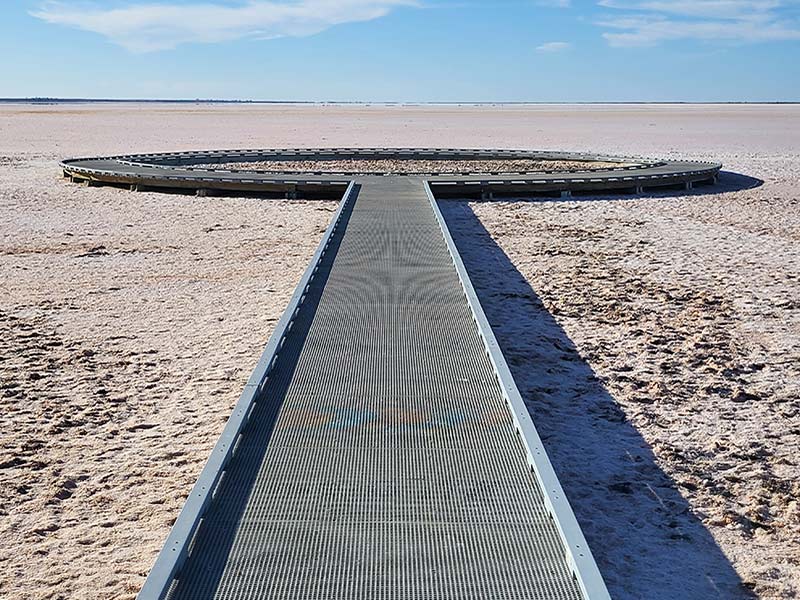
FRP decking for exterior applications includes compounds to resist both fire and UV degradation. FRP with such specifications can achieve NFPA Class A rating under ASTM E84, a flame spread index of 8 (Class A rating requires < 25 and smoke developed Index of 200 (Class A rating requires < 450). It is much more fire resistant than any wood species – hardwood or softwood.
Friendly to Wetlands and Sensitive Locations
Fiberglass boardwalk decking doesn’t require sealing or staining nor is there any danger of preservative chemicals leaching out into waterways or the environment.
The open spaces in fiberglass grating panels allow light and moisture to pass through to the vegetation underneath, enabling plants to grow and ecosystems to flourish.
Also, construction of fiberglass grid boardwalks does not need heavy equipment which could damage sensitive environments – FRP grating panels can be carried on site by hand if necessary.
Blends into the Environment
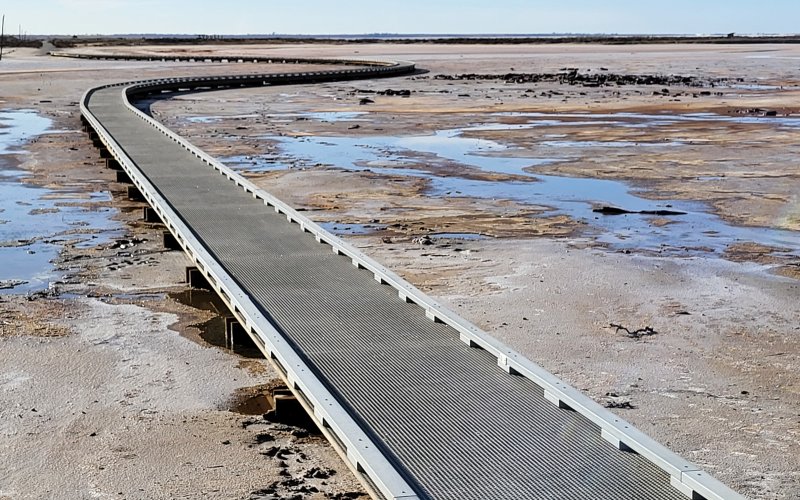
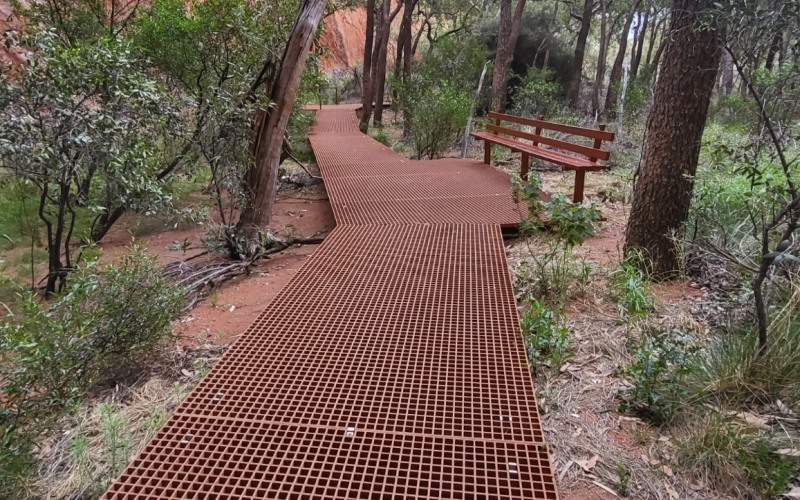
While some people may not immediately take to the perhaps more industrial look of fiberglass panels, there is the offsetting advantage that fiberglass grating panels can be supplied in colors that will blend in extremely well with the surrounding environment, reducing the impact of raised boardwalks. And yes, it does mean that the boardwalk structure would need to be constructed of two materials, typically a steel sub-structure and posts and railings where required. But again, if steel is used, it can be painted in a color to match the FRP and the immediate environment.
Safer Surfaces for Steps and Stairs
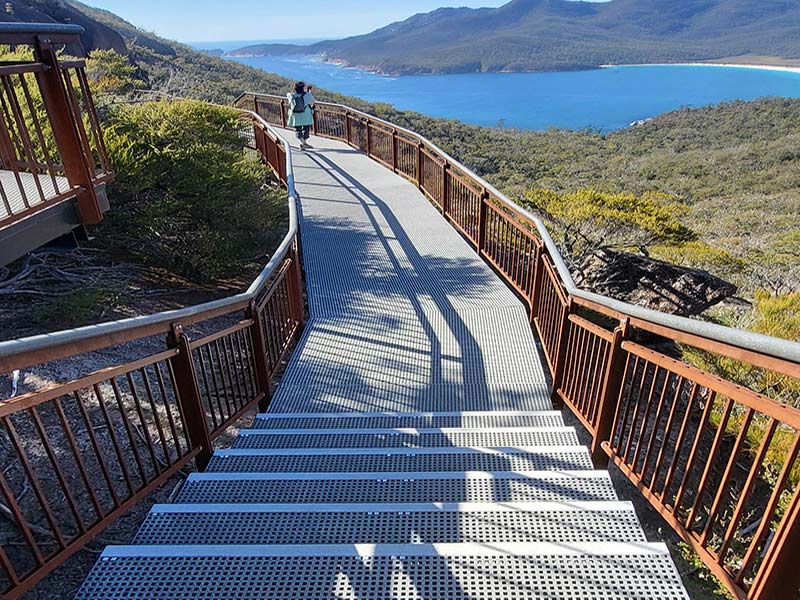
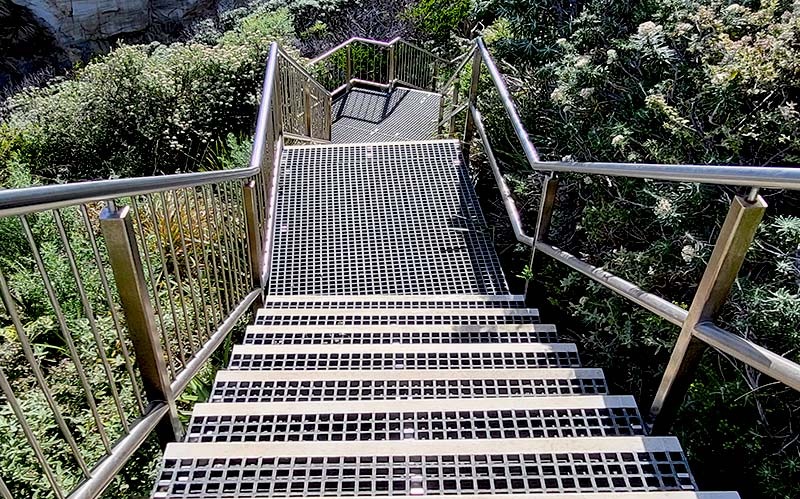
FRP grating would undoubtedly be one of the best materials used for constructing steps and stairs, rivalling steel grating in this respect. It also offers the advantage that the same material can be used on any platforms or viewing platforms which are accessed by the stairs, giving a more aesthetically coordinated look. And the nosing on the stairs can be constructed with a strip of gritted fiberglass supplied in a contrasting color of material, about 2” wide offering both greater visibility and extra slip resistance, thus adding an extra level of safety for pedestrians.
For stairs or beach access ramps however, the gritted surface which normally provides such excellent slip resistance, can prove somewhat hard on the feet for beach users. In such locations there is the alternative of supplying FRP grating panels with a meniscus finish which gives good slip resistance but is not so hard on the bare feet.
Versatile
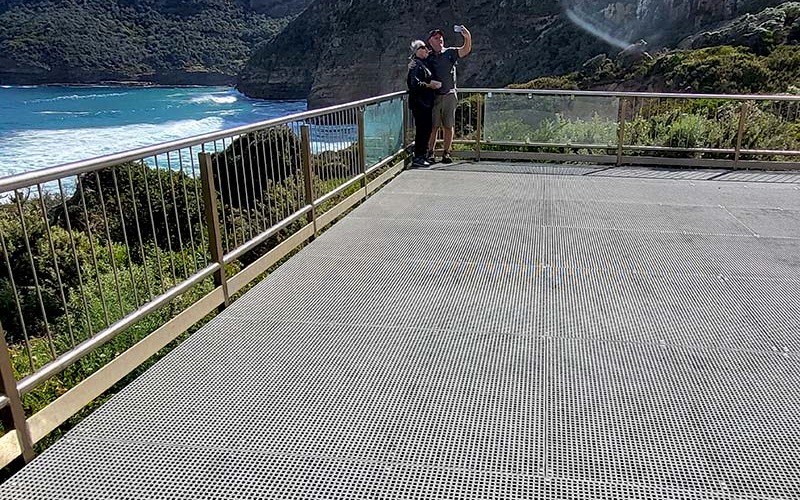
The large panels make ideal surfaces for flat, even, slip resistant viewing platforms but still allow light and water to pass through to the vegetation below. In marshland, the constant presence of water will not rot or degrade the decking. Small bridges can often be resurfaced simply by laying panels over the existing structure. Curved pathways are no problem. Steps and stairs can be supplied to match the deck surfaces with the added safety of extra grit on leading edges of the steps. Panels can be supplied in custom colors to match thesurrounding environment.
Easier to Install
Fiberglass decking is normally supplied as large panels, typically 8” x 4’ rather than single deck boards which need to be fixed individually to bearers.
To install fiberglass grating panels, you just need to lay the panels over the support bearers, making sure that the support structure is level with no high points that could prevent the FRP panels from lying flat.
To attach the panels to the bearers, either clips or screws can be used, depending on the nature of the support structure. Clips will normally be used if installing over steel ‘H’ beams for example, whereas screws may be used if installing over wood bearers, countersunk into the grating surface. To connect the panels together securely, ‘C’ clips are normally used, typically needing to be spaced only at 4’ intervals.
If any grating panels need to be cut, you can use either a power saws or an angle grinder. Proper protection precautions should always be taken when cutting or trimming FRP panels, such as wearing protective gloves, masks and eyewear.
Virtually Maintenance Free
Compared to other materials, and especially wood decking, fiberglass boardwalk decking has very little need for maintenance. There’s no need for sealing, preservation chemicals or replacement of cracked or damaged boards from time to time. It won’t weather and expose dangerous splinters or twist and create a tripping hazard. It won’t build up moss or algae which can create a slippery surface. And of course, FRP grating does not rust like steel.
In summary, although wood has served for an exceptionally long time as the default material for boardwalks, it’s surely time to look at other materials, and in this respect, FRP grating panels present an impressive array of advantages that clearly put then head and shoulders above competitive materials for boardwalk decking.