
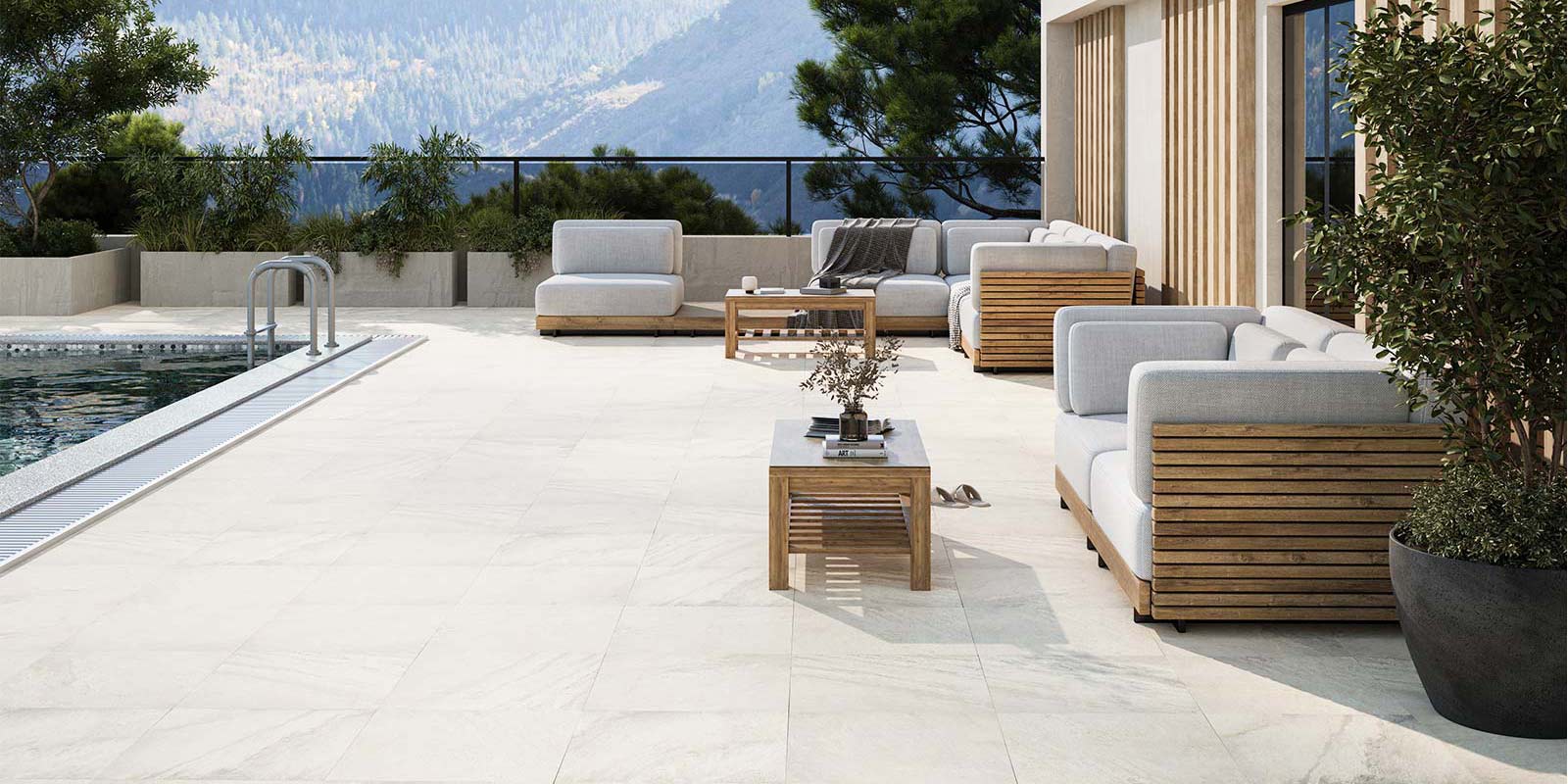
With any building material, porcelain pavers come with both strengths and limitations. When it comes to landscape paving and pedestal-supported rooftop decks, however, we firmly believe porcelain pavers deserve to be at the top of your list for your next project. Below, we break down the key advantages and disadvantages of porcelain paver to help you make an informed decision and decide if they are a good fit for your space.
Advantages of Porcelain Pavers
Highly Durable, Hard Wearing
One of the dominant characteristics of porcelain is its hardness and durability, as borne out by its widespread use over centuries for so many different applications. Porcelain is made of special clays and some special additives – kiln fired to temperatures of 1,200 to 1,400 degrees Fahrenheit, resulting in a hard, durable, wear-resistant material with exceptionally low water absorption. It is exceptionally scratch and wear resistant which helps to explain why so many shopping centers and airports choose porcelain for their floor tiles.
Resistant to Fading and Color Change
Since the colors are baked in at such a high temperature, porcelain colors do not fade, nor do they change color even in the most intense sunlight. You can have absolute confidence that the colors you are seeing on the day the pavers are installed will be the same as you’ll see many years later, unlike the paint on your house or any colored concrete on your driveway.
Lightweight
Since they are only ¾” thick (or 1 1/8” thick in case of the latest 3cm pavers) porcelain pavers are lighter than both concrete and most natural stone, making them easier and more cost-efficient to transport, move to the job site and install. This is especially useful for rooftop deck applications, where porcelain pavers can generally be moved in elevators where necessary, rather than having to bring expensive high reach cranes to the site.
High Aesthetic Value
Porcelain pavers offer an exceptionally rich catalog of styles and colors, significantly broadening the horizons of outdoor design, allowing designers to create visually stimulating spaces, in full harmony with the surrounding environment. Plus, the colors are so much deeper and richer than is possible to achieve with concrete pavers. They also display more variation in light and shade and often incorporate special effects like mica flecks, making the best examples of modern pavers look almost in distinguishable from not only natural stone, but also natural wood as well.
Low Maintenance and Easy Cleaning
Porcelain pavers have practically zero water absorption so don’t require any sealers or protective coatings to seal the surface. Debris and spills including things like oil or grease which are a problem with porous products like concrete, can easily be removed from porcelain using the appropriate cleaning product where necessary to remove all trace of the spill. So, areas around grills or BBQs which can be problematic with many materials (including wood decks) are really no issue at all with porcelain pavers.
Suitable for High Traffic Areas
Developments in technology have enabled the manufacturing of thicker and stronger porcelain pavers, such as our 3cm (11/8”) thick porcelain pavers. Because of their high load-bearing capacity, T30 pavers offer the perfect solution for both vehicular and high-foot traffic applications.
Moss, Mold and Mildew Resistant
The impermeability of porcelain pavers not only prevents penetration by most liquids, oils, grease and chemicals, but makes them exceptionally moss/mold/mildew resistant. If any mold or moss does accumulate because of specific climatic conditions or lack of sunlight, it can be much more easily removed than moss or mildew on concrete or porous stone such as travertine.
More Sizes
Initially porcelain pavers were only available in 24” x 24” size. But in recent years the size options have multiplied significantly. The current Archatrak porcelain paver range includes pavers as massive as 96” x 48”, cobblestone blocks as small as 4” x 4”, and porcelain planks similar to natural wood in 16″, 12″ and 8″ widths and 48” long – sizes impossible to obtain in a concrete paver.
Freeze/thaw resistant
Again, because of their practically zero water absorption, porcelain pavers are not susceptible to freeze/thaw cracking, making them a better choice in cold climates where freeze-thaw cycles can be a concern.
Ideal for Covering Existing Concrete
Since porcelain pavers are so much thinner than concrete pavers, they are an ideal solution for covering weather worn or cracked patios and even for covering existing wood decks. They just need to be supported with rubber pads under each corner of the pavers, yet the height of surface can be a little as 1” higher than your existing surface. Since rubber pads like Archatrak stackable rubber pads have inbuilt spacer tabs, installation is a breeze as spacing and alignment is taken care of automatically.
Disadvantages of Porcelain Pavers
Brittleness
Being such a hard and dense material fired at very high temperatures, porcelain is more brittle than concrete pavers although they are generally similar in brittleness to many types of natural stone. That means that due care needs to be taken when transporting pavers, avoiding dropping the pavers on their corners in particular and taking care installation to avoid any raised edges which might result in chipping.
In applications where the pavers are used on roof deck systems where they are only supported under each corner, you also need to consider the possibility of a paver breaking in service. For this reason, protection devices such as self-adhesive protection sheets or metal plates should always be installed under the pavers at elevations above 4” to avoid the possibility of injury if a paver should break due to impact by a hard object.
Harder to Cut or Drill than Concrete
Due to the particularly hard and dense nature of porcelain as mentioned above, more specialized tools are required for cutting or drilling porcelain pavers. Diamond blades are essential for cutting and for most large projects, a wet saw is generally preferable. When drilling holes, it is essential to use drill bits specifically designed for hard and dense products like porcelain, and care also needs to be taken to avoid cracking the pavers if the correct technique is not followed while drilling.
More Preparation for On-Grade Installation
Because porcelain pavers are thinner than concrete pavers, more care needs to be taken when laying pavers on-grade. While they can certainly be laid over sand or gravel beds, the beds must be prepared with an adequate depth of base material, must be properly compacted, and must be laid on a final layer of sand or fine gravel that has been carefully leveled. For vehicular applications, ¾” thick porcelain pavers must be laid in mortar over reinforced concrete base, although with 1 1/8” thick porcelain pavers like the Archatrak T30 paver range, it is possible to use these for vehicular applications when laid over a properly prepared and compacted gravel base.
More Expensive than Concrete Pavers
Although porcelain pavers have certainly come down in price over the last 5 years or so, generally speaking, they typically come at a higher initial cost compared to concrete. In locations where there is not a concrete manufacturing facility close by, this difference might be quite small since transport costs will typically be much higher for the thicker concrete pavers. But considering their long-term durability, lower maintenance, and enduring aesthetic appeal, porcelain pavers can generally prove to be a more economical option over time.
Conclusion
Despite needing more care in installation, the long list of their advantages makes porcelain pavers a smart investment for both residential and commercial outdoor projects. Their unmatched durability, design versatility, and resistance to wear, weather, and stains place them a step above traditional concrete or natural stone alternatives. While the higher upfront cost may be a disadvantage, the long-term performance and minimal maintenance more than justify the difference in price. Whether you’re renovating a rooftop deck, laying a new patio, or resurfacing a driveway, porcelain pavers are a top-tier solution that delivers both beauty and functionality for many years to come.
—